
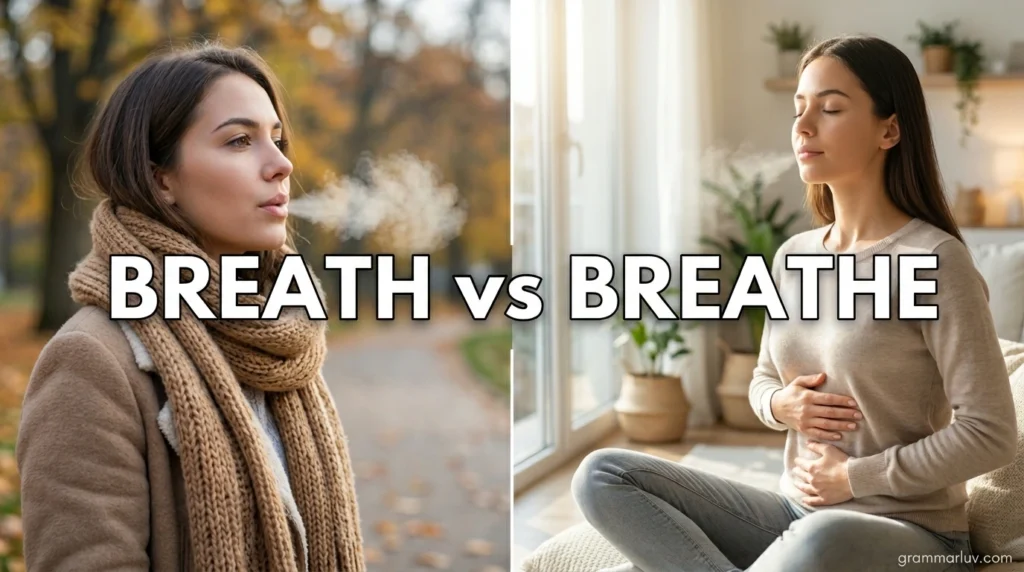
Figurative language makes writing more vivid, engaging, and memorable. Whether you’re crafting a story, composing poetry, writing essays, or improving everyday communication, choosing the right words can dramatically affect clarity and impact. Many English learners and even native speakers struggle with commonly confused word pairs. One of the most frequent examples is breath vs breathe.
Although these words look almost identical, they serve different grammatical functions and meanings. Using the wrong one can create confusion, weaken professional writing, and affect overall communication skills. Understanding the distinction helps improve writing accuracy, vocabulary enhancement, descriptive language, and confidence in both spoken and written English.
This comprehensive guide explains the meanings, differences, usage rules, sentence examples, common mistakes, literary applications, and practical exercises related to these two frequently confused words.
What Do Breath and Breathe Mean?
The confusion often comes from their similar spelling. However, they belong to different parts of speech.
WordPart of SpeechMeaningBreathNounThe air taken into or expelled from the lungsBreatheVerbTo inhale and exhale air
A simple way to remember:
- Breath is a thing.
- Breathe is an action.
Examples
Breath (Noun)
- Take a deep breath before speaking.
- Her breath was visible in the cold air.
- He held his breath during the suspenseful scene.
Breathe (Verb)
- Remember to breathe slowly during meditation.
- It became difficult to breathe because of the smoke.
- She paused to breathe after running.
Why People Confuse These Words

Several factors contribute to the confusion.
Similar Spelling
Only one letter separates the two words.
- Breath
- Breathe
Similar Pronunciation
While similar, they are pronounced differently:
WordPronunciationBreathbrethBreathebreeth
The extra “e” changes the vowel sound.
Frequent Everyday Usage
Both words appear in health discussions, creative writing, literature, conversations, and academic contexts, making confusion common.
Understanding the Grammar Difference
The easiest way to distinguish them is through grammar.
Breath Is a Noun
A noun refers to a person, place, thing, or idea.
Examples:
- His breath smelled like mint.
- One breath can calm your nerves.
- She took a breath before answering.
In each sentence, “breath” represents a thing.
Breathe Is a Verb
A verb expresses action.
Examples:
- Athletes must breathe efficiently.
- Try to breathe deeply.
- Plants help humans breathe cleaner air.
In these examples, “breathe” describes an action.
Quick Comparison Table
FeatureBreathBreathePart of SpeechNounVerbFunctionNames somethingShows actionExampleTake a breathBreathe deeplyPronunciationBrethBreethQuestion It AnswersWhat?What action?Usage FrequencyPhysical object/conceptPhysical activity
Easy Memory Trick
If the word ends with “e”, it usually performs an action.
- Breath = thing
- Breathe = action
When to Use Breath
Use “breath” whenever referring to air, breathing capacity, or a single inhalation or exhalation.
Common Situations
Health and Fitness
- Take a deep breath.
- Control your breath while exercising.
Emotional Reactions
- She gasped for breath.
- The announcement took my breath away.
Medical Contexts
- Shortness of breath can indicate illness.
- The doctor checked his breath sounds.
Sentence Examples
- The runner struggled to catch his breath.
- Every breath felt painful after the accident.
- Her breath formed tiny clouds in the winter air.
- One deep breath helped reduce anxiety.
- The audience held its breath during the final performance.
When to Use Breathe
Use “breathe” whenever discussing the act of inhaling and exhaling.
Common Situations
Physical Activity
- Breathe steadily during exercise.
- Learn to breathe properly while swimming.
Relaxation
- Close your eyes and breathe slowly.
- Breathe deeply to reduce stress.
Environmental Discussions
- We need clean air to breathe.
- Trees help us breathe healthier air.
Sentence Examples
- It was difficult to breathe in the dusty room.
- Remember to breathe through your nose.
- She stopped running to breathe.
- Patients were taught how to breathe correctly.
- Fresh mountain air made it easier to breathe.
Breath and Breathe in Figurative Language
Figurative language adds depth and creativity to writing. Both words frequently appear in literary devices.
Metaphor Examples
A metaphor compares two things without using “like” or “as.”
Examples:
- Hope was the breath of the community.
- Music became the breath of his soul.
- Creativity is the breath of innovation.
Simile Examples
A simile uses “like” or “as.”
Examples:
- She breathed like a person seeing freedom for the first time.
- His relief spread like a fresh breath of spring air.
- The room felt as breathless as a desert afternoon.
Personification
Giving human qualities to nonhuman things.
Examples:
- The forest breathed in the morning mist.
- The city seemed to breathe with excitement.
- The ocean breathed against the shore.
These examples enrich creative writing and descriptive language.
Breath and Breathe in Creative Writing
Writers often use these words to create atmosphere, tension, and emotional depth.
Building Suspense
Examples:
- Everyone held their breath as the door slowly opened.
- She forgot to breathe while waiting for the results.
Showing Emotion
Examples:
- His breath trembled with fear.
- She breathed a sigh of relief.
Creating Vivid Imagery
Examples:
- Cold breath drifted into the night sky.
- The sleeping dragon seemed to breathe fire beneath the mountain.
Such usage strengthens storytelling and literary expression.
Common Idioms and Expressions
English contains many idioms involving breath and breathe.
Take My Breath Away
Meaning: To amaze or impress greatly.
Example:
- The mountain view took my breath away.
Catch Your Breath
Meaning: To recover after exertion.
Example:
- Sit down and catch your breath.
Hold Your Breath
Meaning: To wait anxiously.
Example:
- We held our breath until the winner was announced.
Breathe Easy
Meaning: Feel relieved.
Example:
- Investors could finally breathe easy after the announcement.
A Breath of Fresh Air
Meaning: Something refreshing or new.
Example:
- Her innovative ideas were a breath of fresh air.
Understanding idiom meaning improves vocabulary and comprehension.
Tone and Context Usage
The tone of your writing influences how these words function.
Formal Writing
Examples:
- The patient experienced shortness of breath.
- Subjects were instructed to breathe normally.
Informal Writing
Examples:
- Take a breath and relax.
- Just breathe and stay calm.
Poetic Expression
Examples:
- Your memory remains the breath of my dreams.
- The earth breathes beneath the stars.
Academic Writing
Examples:
- Proper breathing techniques improve athletic performance.
- Breath control is essential for singers.
Choosing the correct word ensures precision and professionalism.
Common Mistakes and How to Avoid Them
Many writers accidentally interchange these words.
Mistake 1
❌ Take a deep breathe.
✅ Take a deep breath.
Reason: The sentence requires a noun.
Mistake 2
❌ Try to breath slowly.
✅ Try to breathe slowly.
Reason: The sentence requires a verb.
Mistake 3
❌ She couldn’t catch her breathe.
✅ She couldn’t catch her breath.
Reason: Catch refers to the noun.
Mistake 4
❌ Remember to breath deeply.
✅ Remember to breathe deeply.
Reason: The sentence describes an action.
Editing Tip
Ask yourself:
“Am I naming something or describing an action?”
- Naming = breath
- Action = breathe
Writing Skills and Vocabulary Enhancement
Mastering subtle word differences improves overall writing quality.
Benefits
Improved Accuracy
Correct word choice reduces grammatical errors.
Better Communication
Readers understand your message immediately.
Stronger Academic Writing
Precise language is valued in schools and professional settings.
Enhanced Creative Writing
Correct usage supports vivid imagery and storytelling.
Expanded Vocabulary
Understanding word relationships strengthens language skills.
Practice Exercises
Test your understanding.
Exercise 1: Fill in the Blank
- Take a deep ______ before speaking.
- Remember to ______ slowly.
- She held her ______ during the movie.
- The fresh air helped him ______ better.
- The surprise took my ______ away.
Answers
- breath
- breathe
- breath
- breathe
- breath
Exercise 2: Choose the Correct Word
- I need to (breath/breathe) after running.
- Her (breath/breathe) smelled like peppermint.
- Please (breath/breathe) calmly.
- He took one deep (breath/breathe).
- The excitement made it hard to (breath/breathe).
Answers
- breathe
- breath
- breathe
- breath
- breathe
Real-Life Comparison Examples
Workplace Communication
Incorrect:
- Take a deep breathe before your presentation.
Correct:
- Take a deep breath before your presentation.
Health Context
Incorrect:
- The patient struggled to breath.
Correct:
- The patient struggled to breathe.
Creative Writing
Incorrect:
- She held her breathe in anticipation.
Correct:
- She held her breath in anticipation.
These comparison examples demonstrate practical application.
FAQs
1. Is breath a noun or a verb?
Breath is a noun that refers to air inhaled or exhaled or a single act of breathing.
2. Is breathe a noun or a verb?
Breathe is a verb that describes the action of inhaling and exhaling air.
3. How do I remember the difference?
The extra “e” in breathe helps indicate an action. Breath names something, while breathe describes doing something.
4. Can both words appear in the same sentence?
Yes.
Example:
- Take a deep breath and breathe slowly.
5. Which word is more common in academic writing?
Both are common, but their usage depends on grammatical context. Breath is used as a noun, while breathe is used as a verb.
Conclusion
Understanding the difference between breath and breathe is an essential step toward stronger communication, better grammar, and more effective writing. While the two words differ by only one letter, they serve entirely different grammatical purposes. Breath is a noun that refers to air or a single inhalation, whereas breathe is a verb describing the act of inhaling and exhaling.
By learning their meanings, pronunciation differences, idiomatic uses, figurative language applications, literary devices, sentence examples, and common mistakes, students, writers, and English learners can confidently use both words in academic, professional, and creative contexts. Mastering distinctions like these enhances writing skills, strengthens vocabulary, improves descriptive language, and helps create clearer, more polished communication in every form of English writing.