
Introduction: Why Figurative Language Improves Writing and Communication
Strong writing is more than correct grammar and vocabulary. Effective communication depends on word choice, tone, imagery, and the ability to create vivid mental pictures for readers. This is where figurative language, descriptive language, literary devices, similes, metaphors, and poetic expression become valuable tools.
Writers, students, and English learners often encounter words that sound alike but differ in spelling, meaning, or acceptance in standard English. Understanding these distinctions improves writing skills, vocabulary enhancement, and overall language accuracy.
One common source of confusion is gaudy vs gawdy. Because both spellings appear similar and are pronounced the same way, many people wonder whether they have different meanings or whether one spelling is incorrect. This article explores the meanings, origins, usage rules, sentence examples, comparison examples, common mistakes, and practical exercises to help you use the correct word confidently.
What Does Gaudy Mean?
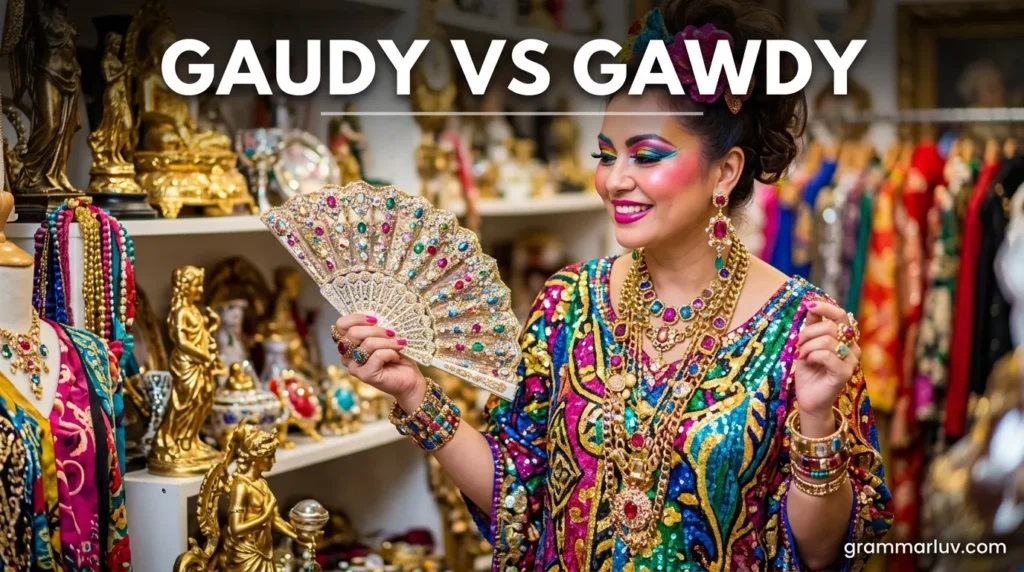
The word gaudy is an adjective used to describe something that is excessively bright, flashy, showy, or ornamented in a way that lacks good taste.
It often refers to:
- Clothing
- Decorations
- Jewelry
- Buildings
- Advertisements
- Colors
- Designs
The term usually carries a negative meaning because it suggests that something is overly decorative rather than elegant.
Simple Definition
Gaudy: excessively bright, colorful, or decorated in a way that appears tasteless or vulgar.
Synonyms
- Flashy
- Showy
- Loud
- Garish
- Overdecorated
- Ornate
- Extravagant
- Glittery
Antonyms
- Elegant
- Modest
- Simple
- Tasteful
- Understated
- Sophisticated
What Does Gawdy Mean?
Gawdy is generally considered a nonstandard or alternative spelling of gaudy.
In modern English dictionaries and academic writing, gaudy is the accepted spelling. While you may occasionally encounter “gawdy” in informal writing, creative works, historical texts, or online content, it is not regarded as the standard form.
Important Rule
For school assignments, professional communication, academic writing, and formal publications, always use gaudy.
Quick Answer
WordStandard English?Recommended UsageGaudyYesAlways preferredGawdyNo (nonstandard)Generally avoid
Origins and History of the Word

Understanding word origins often improves vocabulary development and language mastery.
The word gaudy comes from the Latin word gaudium, meaning “joy” or “rejoicing.”
Over time, the meaning shifted from something joyful and festive to something excessively decorative or flashy.
Historically, bright colors and extravagant decorations were associated with celebrations. Eventually, the term began describing displays that seemed overdone or lacking refinement.
The spelling “gawdy” emerged as a phonetic variation because the pronunciation naturally sounds like “gaw-dee.”
However, standard dictionaries retained gaudy as the official spelling.
Quick Comparison Table
Gaudy vs Gawdy at a Glance
FeatureGaudyGawdyPart of SpeechAdjectiveAlternative spellingAccepted in DictionariesYesRarelyFormal WritingRecommendedNot recommendedAcademic WritingCorrectIncorrectProfessional CommunicationCorrectAvoidMeaningExcessively flashy or showySame meaning when usedPopularityVery commonVery uncommon
How Gaudy Is Used in Everyday English
The word frequently appears when discussing fashion, design, art, architecture, and appearance.
Fashion
- She wore a gaudy necklace covered in oversized gemstones.
- The actor’s costume looked gaudy under the stage lights.
Interior Design
- The room was filled with gaudy decorations and bright gold accents.
- Many designers prefer elegance over gaudy ornamentation.
Advertising
- The billboard used gaudy colors to attract attention.
- Some advertisements rely on gaudy visuals rather than clear messaging.
Architecture
- Critics described the building as gaudy and excessively decorated.
- The hotel featured a gaudy entrance covered in bright lights.
Sentence Examples for Students and Writers
Learning through sentence examples helps strengthen writing skills and comprehension.
Basic Examples
- The store displayed a gaudy collection of brightly colored handbags.
- His gaudy shirt attracted attention wherever he went.
- The festival featured gaudy decorations and colorful banners.
- Many people considered the artwork gaudy rather than beautiful.
- The room’s gaudy wallpaper overwhelmed the space.
Intermediate Examples
- The designer intentionally used gaudy colors to create a dramatic effect.
- Critics argued that the sculpture’s gaudy appearance distracted from its artistic value.
- The casino’s gaudy lights could be seen from miles away.
- Her gaudy accessories clashed with the elegant dress.
- The restaurant’s gaudy décor divided customer opinions.
Advanced Examples
- The novelist described the palace as a gaudy monument to wealth and excess.
- Despite its gaudy exterior, the building housed a sophisticated art collection.
- The director employed gaudy visual effects to emphasize the character’s obsession with luxury.
- The exhibition explored how gaudy aesthetics influence consumer behavior.
- The author’s portrayal of the gaudy mansion symbolized materialism.
Using Gaudy in Creative Writing and Descriptive Language
Creative writing often relies on vivid imagery. Words like gaudy help readers visualize scenes instantly.
Example in Narrative Writing
“The gaudy carnival lights flickered against the night sky, painting the streets with flashes of red, blue, and gold.”
Example in Descriptive Writing
“The bride walked past rows of gaudy decorations that glittered excessively beneath the chandeliers.”
Example in Character Description
“He preferred gaudy suits that reflected his desire to be noticed wherever he went.”
Writers use such descriptive language to create atmosphere, reveal personality, and enhance storytelling.
Figurative Language Examples Using Gaudy
Figurative language adds depth and creativity to writing.
Simile Examples
A simile compares two things using “like” or “as.”
- The jacket was as gaudy as a neon billboard.
- Her earrings sparkled like a gaudy display in a jewelry store.
- The stage decorations were as gaudy as a carnival midway.
Metaphor Examples
A metaphor directly compares two things.
- The mansion was a gaudy crown sitting atop the hill.
- His wardrobe was a gaudy explosion of colors.
- The hotel lobby became a gaudy monument to extravagance.
Personification Example
- The gaudy lights danced across the city skyline.
Hyperbole Example
- The gaudy decorations could probably be seen from outer space.
These literary devices strengthen imagery and reader engagement.
Tone and Context: When to Use the Word Gaudy
Tone plays an important role in communication.
Appropriate Situations
Use gaudy when describing:
- Excessive decoration
- Overly bright colors
- Flashy fashion
- Tasteless luxury
- Over-the-top visual displays
Example
“The banquet hall looked gaudy with its oversized golden ornaments.”
Neutral Context
Sometimes the word simply describes visual intensity without strong criticism.
Example:
“The parade featured gaudy costumes inspired by traditional celebrations.”
Negative Context
More often, the word expresses disapproval.
Example:
“Many reviewers considered the gaudy design distracting.”
When to Avoid Using Gaudy
Although useful, the word is not always appropriate.
Avoid It When:
Describing Elegant Designs
Instead of gaudy, consider:
- Elegant
- Refined
- Sophisticated
Writing Formal Product Descriptions
The word may sound judgmental.
Instead of:
“The furniture looks gaudy.”
Use:
“The furniture features bold decorative elements.”
When Objectivity Is Required
Academic analysis may benefit from more neutral descriptions.
Example:
“The design incorporates highly saturated colors and extensive ornamentation.”
Common Mistakes Learners Make
English learners frequently encounter problems with similar-looking words.
Mistake 1: Using Gawdy in Formal Writing
❌ The house looked gawdy.
✅ The house looked gaudy.
Mistake 2: Confusing Gaudy with Gorgeous
Some learners mistakenly assume gaudy means beautiful.
❌ Her gaudy dress was elegant and tasteful.
✅ Her elegant dress was beautiful and tasteful.
Mistake 3: Overusing the Word
Repeated use can weaken writing.
Instead of using gaudy multiple times, vary your vocabulary:
- Flashy
- Garish
- Showy
- Extravagant
- Ornate
Mistake 4: Applying It to Non-Visual Concepts
The word primarily describes visual appearance.
Less effective:
❌ A gaudy argument.
Better:
✅ A flashy presentation.
Comparison Examples with Similar Words
Understanding related vocabulary helps improve vocabulary enhancement.
WordMeaningToneGaudyExcessively flashyNegativeFlashyAttention-grabbingNeutral to negativeGarishHarshly brightStrongly negativeOrnateElaborately decoratedNeutralElegantGraceful and tastefulPositiveExtravagantExcessively luxuriousMixed
Comparison Sentences
- The elegant ballroom impressed guests with its tasteful design.
- The gaudy ballroom overwhelmed visitors with excessive decoration.
- The ornate ballroom featured detailed craftsmanship.
- The garish ballroom used harsh, clashing colors.
Literary and Poetic Expression
Authors often use descriptive words to create symbolism and mood.
Symbolism
A gaudy object may symbolize:
- Wealth
- Vanity
- Excess
- Materialism
- Superficiality
Example
“The gaudy palace represented the ruler’s obsession with status.”
Poetic Expression
Poets may use the word to contrast beauty and excess.
Example:
“Among the quiet roses stood a gaudy bloom, Brilliant in color, yet lonely in its room.”
Such usage enriches literary analysis and interpretation.
Practice Exercises for English Learners
Exercise 1: Choose the Correct Word
- The hotel lobby looked ______.
- a) gaudy
- b) gawdy
Answer: gaudy
- The designer avoided ______ decorations.
- a) gaudy
- b) gawdy
Answer: gaudy
Exercise 2: Rewrite the Sentence
Original:
“The room had many bright decorations.”
Improved:
“The room featured gaudy decorations that dominated the space.”
Exercise 3: Create a Simile
Example:
“The costume was as gaudy as __________.”
Possible answer:
“The costume was as gaudy as a neon carnival sign.”
Exercise 4: Create a Metaphor
Example:
“The mansion was a gaudy __________.”
Possible answer:
“The mansion was a gaudy jewel in the center of town.”
Exercise 5: Identify Tone
Sentence:
“The critic described the artwork as gaudy.”
Tone:
Negative/Critical
FAQs
1. Is gawdy a real word?
It exists as a rare alternative spelling, but it is not considered standard English. Most dictionaries and style guides recommend using gaudy.
2. Which spelling should students use?
Students should always use gaudy in assignments, exams, and academic writing.
3. Does gaudy always have a negative meaning?
Usually yes, but sometimes it can simply describe something extremely colorful or attention-grabbing without strong criticism.
4. Can gaudy be used in creative writing?
Absolutely. It is a useful descriptive adjective that helps create vivid imagery and character descriptions.
5. What are good synonyms for gaudy?
Common alternatives include flashy, garish, showy, extravagant, ornate, glittery, and overdecorated.
Conclusion
Understanding the difference between gaudy vs gawdy helps students, writers, and English learners avoid common spelling mistakes while improving clarity and precision in communication. The accepted spelling in modern English is gaudy, which describes something excessively bright, flashy, or overly decorated. Although “gawdy” occasionally appears as a nonstandard variation, it should generally be avoided in formal, academic, and professional writing.
Mastering words like gaudy contributes to stronger writing skills, richer descriptive language, and more effective use of figurative language. Whether you’re crafting creative writing, analyzing literary devices, building vocabulary enhancement, or improving everyday communication, knowing the correct spelling and context ensures your writing remains accurate, engaging, and polished.