
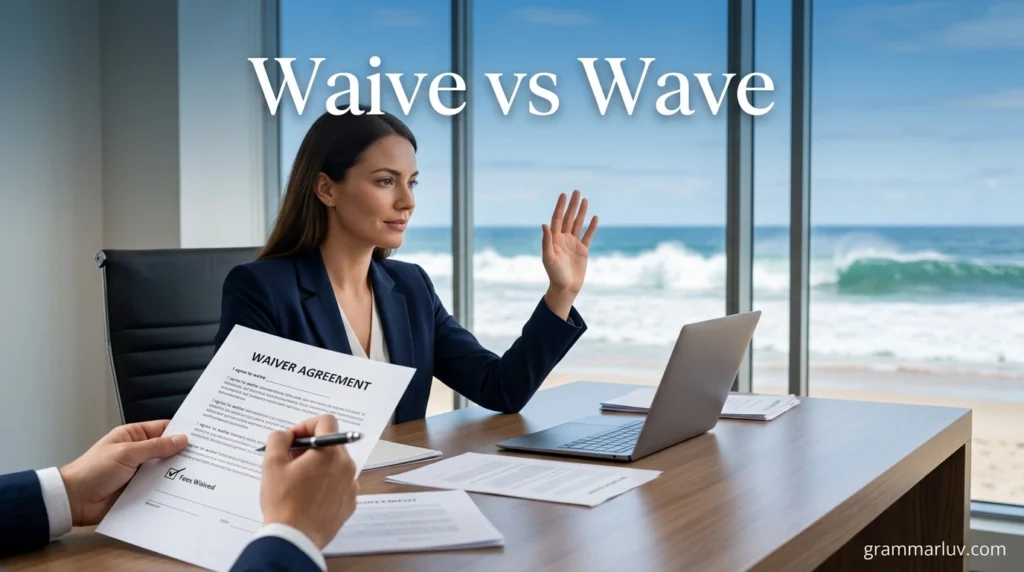
Introduction: Why Figurative Language and Precise Word Choice Matter
Effective communication depends on selecting the right words. Whether you are writing essays, stories, emails, poems, or professional documents, vocabulary accuracy helps readers understand your intended meaning. Even a small spelling difference can create confusion and change the entire message.
This is particularly true when dealing with commonly confused words like waive vs wave. Although they sound alike, they have very different meanings and uses. Many students, writers, and English learners accidentally interchange them because they are homophones—words that share pronunciation but differ in meaning and spelling.
Mastering these distinctions improves writing skills, vocabulary enhancement, descriptive language, and overall communication. It also helps writers use figurative language, literary devices, poetic expression, simile examples, and metaphor examples more effectively without introducing errors.
In this guide, you’ll learn the meanings, differences, sentence examples, tone usage, common mistakes, practical exercises, and tips for remembering when to use each word.
What Does “Waive” Mean?
The word waive is a verb that means to voluntarily give up, surrender, decline, or forgo a right, claim, rule, fee, or requirement.
When someone waives something, they intentionally choose not to enforce or exercise it.
Definition
Waive = To give up a right, privilege, requirement, or claim voluntarily
Common Situations
- Legal agreements
- School requirements
- Membership fees
- Contract conditions
- Formal permissions
Sentence Examples
- The university agreed to waive the application fee.
- She decided to waive her right to appeal.
- The company waived the late payment charge.
- The customer requested that the penalty be waived.
- The judge waived certain procedural requirements.
Tone and Usage
“Waive” is generally used in:
- Formal writing
- Academic documents
- Business communication
- Legal language
- Administrative settings
What Does “Wave” Mean?
The word wave can function as both a noun and a verb.
As a verb, it means to move your hand or an object back and forth.
As a noun, it refers to a moving swell of water or any similar movement pattern.
Definition
Wave = A gesture, movement, or flowing motion
Common Uses
- Greeting someone
- Ocean waves
- Physical movement
- Signal gestures
- Figurative descriptions
Sentence Examples
- She waved goodbye from the train.
- The children waved their flags proudly.
- A huge wave crashed against the rocks.
- He waved to attract attention.
- The crowd waved enthusiastically.
Tone and Usage
“Wave” appears in:
- Everyday conversation
- Creative writing
- Narrative storytelling
- Journalism
- Poetry
Quick Comparison Table
FeatureWaiveWavePart of SpeechVerbNoun and VerbMain MeaningGive up a rightMove back and forthCommon ContextLegal, formal, businessEveryday actions, natureExampleWaive a feeWave your handToneFormalNeutral and common
Key Differences Between Waive and Wave
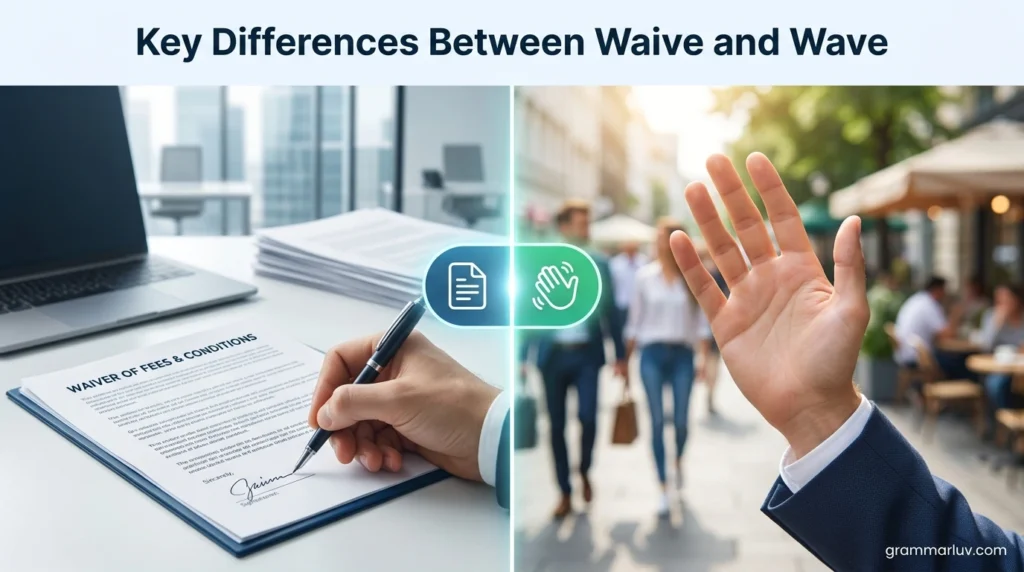
Although they sound identical, their meanings are completely unrelated.
Waive
Focuses on:
- Permission
- Rights
- Rules
- Requirements
- Formal decisions
Example:
“The manager agreed to waive the service charge.”
Wave
Focuses on:
- Motion
- Gestures
- Water movement
- Signals
- Physical action
Example:
“The manager gave a friendly wave.”
A simple memory trick:
Waive = Give Away
Both contain the letters “aive.”
Wave = Hand Movement
Think of a hand moving in a wave pattern.
When to Use “Waive”
Use “waive” whenever someone intentionally chooses not to enforce, claim, or require something.
Correct Situations
Fees
- The bank waived the annual fee.
Requirements
- The school waived the language requirement.
Rights
- He waived his right to legal counsel.
Rules
- The organization waived the deadline.
Academic Example
“The professor waived the attendance requirement due to exceptional circumstances.”
When to Use “Wave”
Use “wave” when describing motion, gestures, or physical movement.
Correct Situations
Greetings
- She waved hello.
Signals
- The guard waved traffic forward.
Water Movement
- The wave reached the shoreline.
Creative Descriptions
- Golden wheat waved in the wind.
Narrative Example
“He stood at the dock and waved until the ship disappeared.”
Waive vs Wave in Creative Writing
Creative writers often use “wave” because it creates vivid imagery and supports descriptive language.
Example
“The grass waved like dancers beneath the summer breeze.”
This sentence creates visual imagery and strengthens poetic expression.
“Waive,” on the other hand, rarely appears in creative storytelling because it is primarily formal and administrative.
Example
“The king waived the tax for struggling farmers.”
Here, “waive” contributes to plot and decision-making rather than imagery.
Figurative Language and Literary Devices Using “Wave”
Because “wave” relates to movement, it appears frequently in figurative language.
Simile Examples
- Her hair flowed like a wave across her shoulders.
- The crowd moved like waves in the ocean.
- His emotions rose and fell like waves.
Metaphor Examples
- A wave of excitement swept through the audience.
- Waves of fear filled the room.
- A wave of happiness spread across the city.
Personification Examples
- The waves danced along the shore.
- The ocean waves whispered secrets.
These literary devices make writing more engaging and memorable.
Common Expressions and Idioms
Expressions with Wave
Make Waves
Meaning: Cause change or disruption.
Example:
“The new employee wasn’t afraid to make waves.”
Wave of Support
Meaning: A large amount of support.
Example:
“The campaign received a wave of encouragement.”
Wave of Emotion
Meaning: Strong feelings spreading suddenly.
Example:
“A wave of relief came over her.”
Expressions with Waive
While fewer idioms use “waive,” it commonly appears in formal phrases:
- Waive a fee
- Waive a requirement
- Waive a right
- Waive a condition
Common Mistakes Students Make
Mistake 1
❌ The university agreed to wave the fee.
✅ The university agreed to waive the fee.
Reason:
A fee can be removed, not physically moved.
Mistake 2
❌ She waived goodbye to her friends.
✅ She waved goodbye to her friends.
Reason:
Goodbye involves a gesture.
Mistake 3
❌ The judge waved the requirement.
✅ The judge waived the requirement.
Reason:
Requirements are formally removed.
Mistake 4
❌ He waive his hand.
✅ He waved his hand.
Reason:
Hand movement requires “wave.”
Sentence Examples for Practice
Waive Examples
- The airline waived the cancellation fee.
- The organization waived membership charges.
- The coach waived the training requirement.
- The court waived several restrictions.
- The university waived tuition penalties.
Wave Examples
- The child waved from the window.
- Ocean waves crashed loudly.
- The fans waved banners during the game.
- She gave a cheerful wave.
- Palm trees waved in the breeze.
Vocabulary Enhancement: Related Words
Words Related to Waive
- Relinquish
- Surrender
- Forgo
- Abandon
- Renounce
- Exempt
- Release
Words Related to Wave
- Gesture
- Signal
- Motion
- Swing
- Ripple
- Surge
- Current
Learning related vocabulary improves both comprehension and writing variety.
Practice Exercises
Exercise 1: Fill in the Blank
Choose “waive” or “wave.”
- The bank agreed to _____ the fee.
- She gave a friendly _____.
- The judge decided to _____ the requirement.
- The children _____ to their parents.
- A giant ocean _____ approached the shore.
Answers
- waive
- wave
- waive
- waved
- wave
Exercise 2: Correct the Error
- The school waved the application fee.
- He waived goodbye from the balcony.
- The company waved the penalty charge.
Answers
- waived
- waved
- waived
Tips for Remembering the Difference
Remember “Waive” as Giving Something Away
If you are removing, surrendering, or excusing a rule, use “waive.”
Example:
- Waive a fee.
- Waive a right.
Remember “Wave” as Movement
If something moves, gestures, or flows, use “wave.”
Example:
- Wave your hand.
- Ocean wave.
Quick Memory Trick
Waive = Give Away
Wave = Motion You Can See
FAQs
1. Are waive and wave pronounced the same?
Yes. They are homophones and share the same pronunciation.
2. Can waive be used as a noun?
No. “Waive” is generally used as a verb.
3. Can wave be both a noun and a verb?
Yes. It can describe an object or movement and can also describe an action.
4. Which word is more common in everyday conversation?
“Wave” is much more common because people frequently discuss gestures and movement.
5. Why do learners confuse waive and wave?
They sound identical, making them easy to mix up in writing despite their different meanings.
Conclusion
Understanding the difference between waive and wave is essential for clear and accurate communication. While they sound alike, their meanings are entirely different. “Waive” refers to voluntarily giving up a right, requirement, or fee, whereas “wave” refers to movement, gestures, or flowing motion.
By learning their definitions, contexts, comparison examples, sentence examples, and common mistakes, students and writers can improve grammar accuracy, writing skills, vocabulary development, and descriptive language. Whether you’re drafting an academic paper, composing professional correspondence, or creating imaginative stories filled with figurative language and literary devices, choosing the correct word ensures your message remains clear, polished, and effective.