
Introduction: Why Strong Language Choices Improve Writing
Good writing is more than correct grammar and spelling. It is about choosing the right words to communicate ideas clearly and effectively. Whether you are writing essays, stories, emails, poems, or academic papers, vocabulary plays a major role in how readers understand your message.
Figurative language, descriptive language, literary devices, poetic expression, and precise word choice all contribute to stronger communication. However, many English learners and even native speakers sometimes confuse words that are closely related. One common example is the difference between prove and proof.
Understanding the distinction between these two terms can significantly improve writing skills, vocabulary enhancement, and overall language accuracy. This guide explains their meanings, grammatical functions, sentence examples, usage rules, common mistakes, and practical exercises to help you master them confidently.
What Do Prove and Proof Mean?
Although these words are related, they perform different functions in English.
WordPart of SpeechMeaningProveVerbTo demonstrate that something is trueProofNounEvidence showing something is true
Simply put:
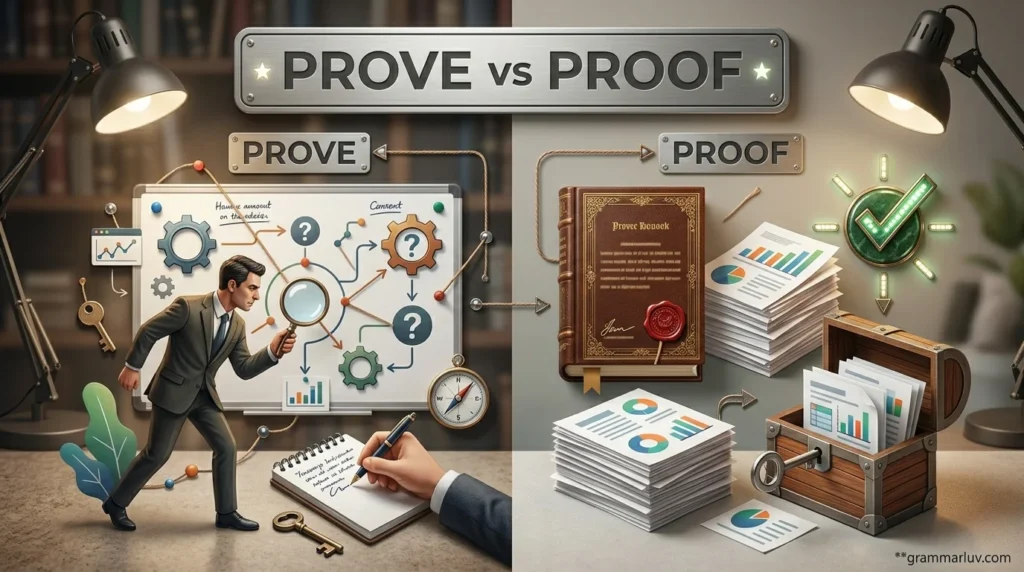
- Prove is an action.
- Proof is the evidence produced by that action.
Basic Examples
- I can prove that I submitted the assignment.
- The receipt is proof that I submitted the assignment.
In the first sentence, the speaker performs an action.
In the second sentence, the receipt serves as evidence.
Understanding the Grammatical Difference
One of the easiest ways to distinguish these words is by identifying their grammatical roles.
Prove as a Verb
A verb expresses an action.
Examples:
- Scientists work to prove new theories.
- The lawyer must prove the defendant’s innocence.
- She hopes to prove her abilities.
Proof as a Noun
A noun refers to a thing, person, place, or idea.
Examples:
- We need proof before making a decision.
- The photograph provides proof.
- The witness offered proof of the event.
Quick Rule
If you need an action word, use prove.
If you need evidence or documentation, use proof.
Why People Confuse These Words
Several factors contribute to confusion.
Similar Origins
Both words come from the same linguistic family and share related meanings.
Similar Contexts
They often appear in legal, academic, scientific, and everyday discussions.
For example:
- Can you prove it?
- Do you have proof?
The subject matter is identical, but the grammar differs.
Language Learning Challenges
English learners often focus on meaning rather than sentence structure, causing verbs and nouns to be mixed up.
Incorrect:
- I have prove.
Correct:
- I have proof.
Incorrect:
- The document proofs my claim.
Correct:
- The document proves my claim.
When to Use Prove
Use prove whenever someone demonstrates, establishes, confirms, or verifies something.
Academic Writing
- Researchers must prove their hypotheses.
- Data helps prove scientific conclusions.
Legal Writing
- Prosecutors attempt to prove guilt.
- Attorneys work to prove innocence.
Everyday Communication
- Can you prove your identity?
- She wants to prove that she is trustworthy.
Professional Communication
- Employees must prove their skills.
- Results help prove the effectiveness of a strategy.
Creative Writing
Writers frequently use the word in character development.
Example:
- The young hero set out to prove his courage.
When to Use Proof
Use proof when referring to evidence, documentation, or confirmation.
Academic Context
- The experiment provided proof of the theory.
- Additional proof is required before publication.
Legal Context
- The court examined the proof carefully.
- Physical proof strengthened the case.
Everyday Context
- Keep proof of purchase.
- The email serves as proof of registration.
Business Context
- Clients often request proof of payment.
- Companies maintain proof of compliance.
Comparison Table: Prove vs Proof
FeatureProveProofPart of SpeechVerbNounFunctionActionEvidenceAnswers QuestionWhat is being done?What evidence exists?ExampleI can prove it.I have proof.Used AfterSubjectArticles, adjectives, prepositionsCommon ContextsLegal, scientific, personalLegal, scientific, business
Side-by-Side Examples
ProveProofShe will prove her point.She has proof of her point.They must prove the claim.They need proof of the claim.Scientists prove theories.Experiments provide proof.
Sentence Examples for Better Understanding
Simple Sentences
Using Prove
- I can prove my statement.
- They will prove the results tomorrow.
- He wants to prove his dedication.
- We need data to prove the conclusion.
- The student tried to prove the answer.
Using Proof
- The report is proof of success.
- We found proof yesterday.
- The certificate provides proof.
- She brought proof to the meeting.
- There is no proof available.
Intermediate Sentences
- The scientist used several experiments to prove the theory.
- Strong evidence served as proof of the discovery.
- The athlete worked hard to prove his abilities.
- The award became proof of her achievement.
Advanced Sentences
- Historical records help prove that the event occurred centuries ago.
- The newly discovered documents provide compelling proof of the agreement.
Using Prove and Proof in Figurative Language
Figurative language makes writing more vivid and engaging.
Metaphor Examples
A metaphor compares two things without using “like” or “as.”
Examples:
- Her success was proof of years of determination.
- The trophy was proof that perseverance wins.
Simile Examples
A simile compares using “like” or “as.”
Examples:
- The evidence was as clear as daylight, proving the accusation.
- His argument stood like proof carved in stone.
Poetic Expression
Poets often use these words symbolically.
Examples:
- The sunrise proved that darkness never lasts forever.
- The blooming flower became proof of renewal.
Creative Writing Examples
- The scar was proof of battles survived.
- The journey proved her inner strength.
Such uses enrich descriptive language and strengthen emotional impact.
Literary Devices and Contextual Usage
Writers frequently employ these words through various literary devices.
Symbolism
Example:
- The old letter became proof of a forgotten friendship.
Personification
Example:
- Time proved the wisdom of her choices.
Hyperbole
Example:
- I have a mountain of proof.
Irony
Example:
- He claimed honesty, but the proof suggested otherwise.
These literary devices make narratives more memorable and engaging.
Tone and Style Considerations
The choice between these words affects tone.
Formal Tone
- The data proves the hypothesis.
- The evidence provides proof.
Academic Tone
- Researchers sought to prove causation.
- Statistical proof supported the findings.
Professional Tone
- The company must prove compliance.
- Proof of certification is required.
Informal Tone
- Can you prove that?
- Do you have proof?
Both words work well in formal and casual communication when used correctly.
Common Mistakes and How to Avoid Them
Mistake 1: Using Proof as a Verb
Incorrect:
- Can you proof your claim?
Correct:
- Can you prove your claim?
Mistake 2: Using Prove as a Noun
Incorrect:
- I need some prove.
Correct:
- I need some proof.
Mistake 3: Confusing Proof and Evidence
While similar, they are not always identical.
Evidence may contribute to proof, but evidence does not automatically become proof until it convincingly establishes a fact.
Mistake 4: Incorrect Verb Forms
Correct forms include:
- Prove
- Proves
- Proved
- Proven
Examples:
- She proved her point.
- The claim has been proven.
Quick Correction Guide
IncorrectCorrectI need prove.I need proof.Can you proof it?Can you prove it?The paper proofs it.The paper proves it.We found prove.We found proof.
Idiom Meaning and Related Expressions
English contains many expressions involving evidence and verification.
Proof Is in the Pudding
Meaning:
The true value of something can only be judged by its results.
Example:
- The project seemed risky, but the proof is in the pudding.
Prove Your Worth
Meaning:
Demonstrate value through actions.
Example:
- New employees often need to prove their worth.
Living Proof
Meaning:
A person who serves as evidence.
Example:
- She is living proof that persistence pays off.
Positive Proof
Meaning:
Conclusive evidence.
Example:
- The fingerprints provided positive proof.
These expressions enrich vocabulary and improve conversational fluency.
Writing Skills and Vocabulary Enhancement Tips
Mastering related word pairs improves language precision.
Read Widely
Books, articles, and essays expose you to proper usage patterns.
Practice Sentence Construction
Write five sentences using each word.
Learn Word Families
Related forms include:
WordTypeProveVerbProvedVerbProvenVerbProofNounProoflessAdjective
Edit Your Writing
After drafting:
- Check nouns and verbs carefully.
- Ensure evidence-related references use proof.
- Ensure action-related references use prove.
Use Context Clues
Ask:
“Am I describing an action or evidence?”
The answer usually reveals the correct choice.
Practice Exercises
Exercise 1: Fill in the Blank
- Can you _____ that statement?
- The receipt is _____ of payment.
- Scientists hope to _____ their theory.
- We need more _____ before proceeding.
- The documents _____ his innocence.
Answers
- prove
- proof
- prove
- proof
- prove
Exercise 2: Correct the Errors
- I need prove.
- The photo proves of ownership.
- Can you proof your claim?
- We found many proves.
Corrected Versions
- I need proof.
- The photo is proof of ownership.
- Can you prove your claim?
- We found much proof.
Exercise 3: Create Your Own Sentences
Write:
- Three sentences using prove.
- Three sentences using proof.
- One metaphor using proof.
- One simile using prove.
This exercise strengthens vocabulary retention and writing confidence.
FAQs
1. What is the main difference between prove and proof?
Prove is a verb meaning to demonstrate something is true, while proof is a noun referring to evidence that confirms truth.
2. Can proof be used as a verb?
In standard grammar, proof is primarily a noun. Although “proofread” exists as a verb, proof itself should generally not replace prove.
3. Which word is more common in academic writing?
Both are common. Researchers often use prove when discussing actions and proof when discussing evidence.
4. Is proven correct English?
Yes. Proven is a widely accepted past participle form, especially in modern English.
Examples:
- The theory has been proven.
- The method is proven effective.
5. How can I remember the difference easily?
Think of:
- Prove = action.
- Proof = evidence.
If someone does something, use prove. If something serves as evidence, use proof.
Conclusion
Understanding the distinction between prove and proof is essential for accurate communication, stronger writing skills, and vocabulary enhancement. While the two words are closely connected in meaning, they serve different grammatical purposes. Prove is the action of demonstrating truth, whereas proof is the evidence that supports that truth.
Whether you are writing academic essays, professional reports, creative stories, poetry, or everyday messages, using these terms correctly improves clarity and credibility. Combined with figurative language, descriptive language, simile examples, metaphor examples, literary devices, and thoughtful word choice, mastering this distinction helps elevate your English proficiency and creates more polished, effective communication.