
Introduction: Why Figurative Language Improves Writing and Communication
Strong communication depends on choosing the right words at the right time. Whether you are writing an academic essay, a creative story, a poem, or a social media post, vocabulary plays a crucial role in expressing ideas clearly. Figurative language, descriptive language, and literary devices enrich writing by making it more vivid, memorable, and engaging.
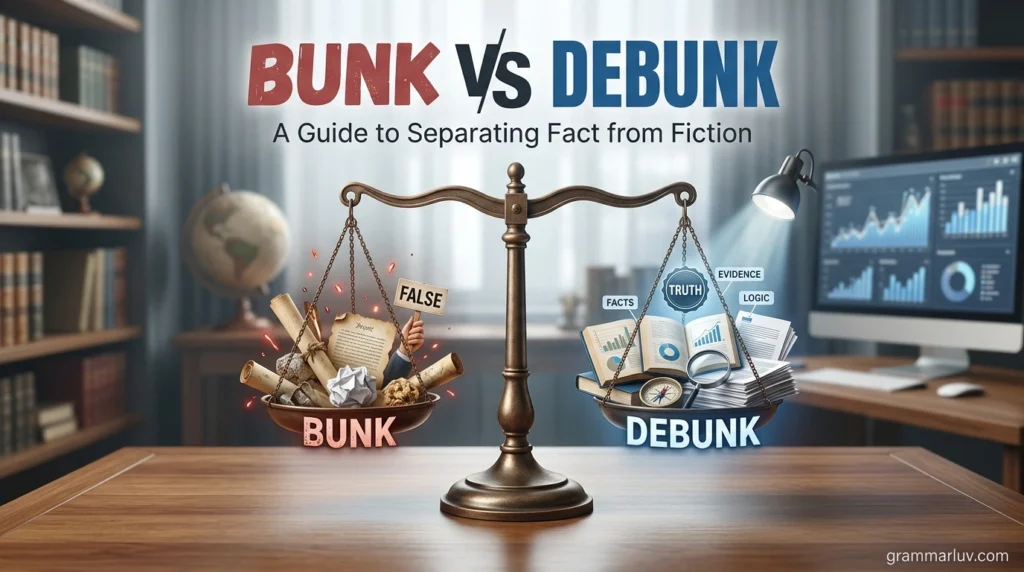
English learners often encounter words that seem related but have very different meanings. One such pair is bunk vs debunk. Although these words share similar spelling, they serve completely different purposes in communication. Understanding their meanings, usage, tone, and contexts can significantly improve writing skills, vocabulary enhancement, and language accuracy.
This guide explores their definitions, differences, sentence examples, common mistakes, creative writing applications, and practical exercises to help students, writers, and English learners master these terms confidently.
What Does “Bunk” Mean?
The word bunk has multiple meanings depending on the context.
Meaning 1: Nonsense or False Information
In informal English, bunk refers to nonsense, foolish ideas, or statements that are not true.
Examples:
- That’s complete bunk.
- The rumor turned out to be bunk.
- Many people believed the bunk spread online.
Meaning 2: A Bed
A bunk can also refer to a narrow bed, especially one of two beds arranged one above the other.
Examples:
- The children slept in bunk beds.
- He climbed onto the top bunk.
Meaning 3: To Leave Quickly (Informal)
In some regional usages, bunk can mean to run away or leave suddenly.
Examples:
- The students bunked class.
- He bunked off work early.
Tone and Style
UsageToneNonsenseInformalBedNeutralLeaving suddenlyInformal/Regional
What Does “Debunk” Mean?
Debunk means to expose something as false, exaggerated, or misleading.
When someone debunks a claim, myth, rumor, or theory, they provide evidence showing why it is incorrect.
Examples
- Scientists debunked the myth.
- Journalists worked to debunk false reports.
- Researchers debunked the conspiracy theory.
Key Characteristics
Debunking usually involves:
- Evidence
- Facts
- Investigation
- Logical reasoning
- Verification
Tone and Style
UsageToneExposing falsehoodsFormalCorrecting misinformationAcademicFact-checking claimsProfessional
Quick Comparison Table
FeatureBunkDebunkPart of SpeechNoun/VerbVerbMain MeaningNonsense or false ideasProve something falseToneInformalNeutral to formalRequires Evidence?NoYesCommon ContextsRumors, nonsense, slangResearch, journalism, sciencePositive or Negative?Usually negativeUsually positive
Simple Formula
- Bunk = false information
- Debunk = expose false information
Origins and Word History
Understanding etymology helps learners remember vocabulary more effectively.
Bunk
The term gained popularity in American English during the nineteenth century. Over time, it came to mean foolish talk or nonsense.
Debunk
The word emerged in the twentieth century from the idea of removing or exposing “bunk.” It literally means to strip away false claims and reveal the truth.
This historical connection explains why the two words look related.
When to Use “Bunk”
Use bunk when referring to ideas, statements, rumors, or beliefs that are considered nonsense.
Appropriate Situations
- Casual conversations
- Informal writing
- Opinion pieces
- Everyday discussions
Sentence Examples
- The advertisement was full of bunk.
- Most experts dismissed the claim as bunk.
- He realized the story was complete bunk.
- Many online rumors are pure bunk.
- The speaker’s argument sounded like bunk to the audience.
Tone Considerations
Because the word can sound dismissive, it should be used carefully in professional settings.
Better Alternatives in Formal Writing
Instead of bunk, use:
- misinformation
- falsehood
- inaccurate claim
- misconception
- unsupported statement
When to Use “Debunk”
Use debunk when evidence is available to prove something false.
Appropriate Situations
- Academic writing
- Journalism
- Research papers
- Fact-checking articles
- Scientific discussions
Sentence Examples
- Researchers debunked the theory through experiments.
- Historians debunked the myth using primary sources.
- The documentary debunked several common misconceptions.
- Scientists continue to debunk misinformation online.
- Experts debunked the exaggerated claims.
Strong Writing Tip
Use debunk when discussing investigation and proof. It adds precision and authority to your writing.
Bunk and Debunk in Creative Writing
Creative writing often relies on descriptive language, literary devices, and figurative language to create engaging narratives.
Example in Fiction
Narrative Sentence
“The old sailor’s tale sounded like bunk, yet every child in the village listened with fascination.”
Example with Debunk
“The detective gathered enough evidence to debunk every rumor surrounding the mansion.”
Why Writers Use These Words
They help:
- Create conflict
- Show skepticism
- Reveal truth
- Build suspense
- Develop character perspectives
Character Voice Examples
Skeptical Character
“That’s absolute bunk.”
Logical Character
“Let me examine the evidence before I debunk the claim.”
Figurative Language Applications
Figurative language enhances communication by making ideas more vivid and memorable.
Metaphor Examples
A metaphor compares two things directly.
- The rumor was a wildfire of bunk spreading through town.
- False information became a mountain blocking the truth.
Simile Examples
A simile uses “like” or “as.”
- The claim collapsed like a house of cards once experts debunked it.
- The rumor spread as quickly as lightning.
Personification
- The myth refused to die despite efforts to debunk it.
- Truth chased the bunk from the room.
Hyperbole
- There was enough bunk online to fill an ocean.
These examples demonstrate how literary devices strengthen writing and improve reader engagement.
Comparison Examples in Different Contexts
Academic Context
❌ The theory was bunk.
✅ Researchers debunked the theory after extensive testing.
Journalism Context
❌ The report contained bunk.
✅ Investigators debunked the false allegations.
Everyday Conversation
✔ That’s bunk.
✔ They debunked the rumor yesterday.
Social Media Context
✔ Fact-checkers debunked the viral claim.
✔ Don’t believe every piece of bunk you read online.
Common Mistakes and How to Avoid Them
English learners frequently confuse these terms because of their similar appearance.
Mistake 1: Using Them Interchangeably
❌ Scientists bunked the theory.
✅ Scientists debunked the theory.
Mistake 2: Treating “Debunk” as a Noun
❌ The debunk was successful.
✅ The debunking was successful.
Mistake 3: Using “Bunk” in Formal Research
❌ The study proved the hypothesis was bunk.
✅ The study demonstrated that the hypothesis was inaccurate.
Mistake 4: Forgetting Evidence
Debunking requires proof.
❌ I debunked the claim because I disliked it.
✅ I debunked the claim using verified evidence.
Sentence Examples by Category
School and Education
- The teacher debunked a common grammar myth.
- Students learned how to identify bunk information.
Science
- Scientists debunked the misconception.
- The article contained scientific bunk.
Media
- Journalists debunked the viral story.
- Readers criticized the publication for spreading bunk.
Business
- Analysts debunked unrealistic projections.
- Investors ignored the bunk circulating online.
Everyday Life
- Grandma called the rumor bunk.
- Experts quickly debunked the story.
Vocabulary Enhancement: Related Words and Synonyms
Synonyms of Bunk
WordMeaningNonsenseMeaningless talkRubbishFoolish ideasBaloneyInformal nonsenseGarbageWorthless informationHogwashAbsurd claims
Synonyms of Debunk
WordMeaningRefuteProve wrongDisproveShow falseExposeReveal truthChallengeQuestion validityCorrectRemove errors
Related NLP and Semantic Terms
- myth
- misconception
- misinformation
- disinformation
- evidence
- fact-checking
- credibility
- truth
- verification
- skepticism
- logic
- reasoning
These related terms help improve semantic SEO and vocabulary development.
Tone, Audience, and Writing Style
Choosing the right word depends on audience and purpose.
AudiencePreferred WordFriendsBunkBloggersEitherJournalistsDebunkResearchersDebunkStudentsContext-dependent
Formal Writing
Prefer:
- debunk
- refute
- disprove
Informal Writing
Prefer:
- bunk
- nonsense
- rubbish
Understanding tone improves communication effectiveness and writing skills.
Practice Exercises
Exercise 1: Fill in the Blank
- Scientists __________ the myth.
- The rumor was complete __________.
- Journalists worked to __________ the false report.
- Most people eventually realized the story was __________.
- Researchers used data to __________ the claim.
Answers
- debunked
- bunk
- debunk
- bunk
- debunk
Exercise 2: Correct the Mistake
- Experts bunked the theory.
- The debunk was published yesterday.
- The scientific paper called the evidence bunk.
Suggested Corrections
- Experts debunked the theory.
- The debunking was published yesterday.
- The scientific paper stated the claim was unsupported.
Exercise 3: Creative Writing Challenge
Write five sentences that include:
- one metaphor
- one simile
- one example of descriptive language
- one use of bunk
- one use of debunk
This exercise strengthens poetic expression and creative writing ability.
FAQs
1. Are bunk and debunk opposites?
Not exactly. Bunk refers to nonsense or false information, while debunk means proving that information false.
2. Is debunk a formal word?
Yes. It is commonly used in journalism, research, education, and professional communication.
3. Can bunk be used in academic writing?
Generally, no. Academic writing prefers terms such as misinformation, misconception, or unsupported claim.
4. What is the difference between debunk and disprove?
Both show something is false, but debunk often refers to exposing myths, rumors, or misconceptions, while disprove focuses on proving a statement incorrect through evidence.
5. Why do English learners confuse these words?
Their similar spelling makes them appear related, but their grammatical functions and meanings are different.
Conclusion
Mastering the distinction between bunk and debunk helps students, writers, and English learners communicate with greater precision and confidence. While bunk usually refers to nonsense, false ideas, or misleading claims, debunk involves exposing those claims through facts, evidence, and logical reasoning. Understanding when to use each term improves vocabulary enhancement, writing skills, descriptive language, and overall communication effectiveness.
Whether you are analyzing literature, creating persuasive essays, developing creative writing projects, studying figurative language, or fact-checking information, knowing the difference between these commonly confused words will strengthen your command of English. By practicing sentence examples, exploring literary devices such as similes and metaphors, and paying attention to tone and audience, you can use both terms accurately and effectively in any writing situation.