
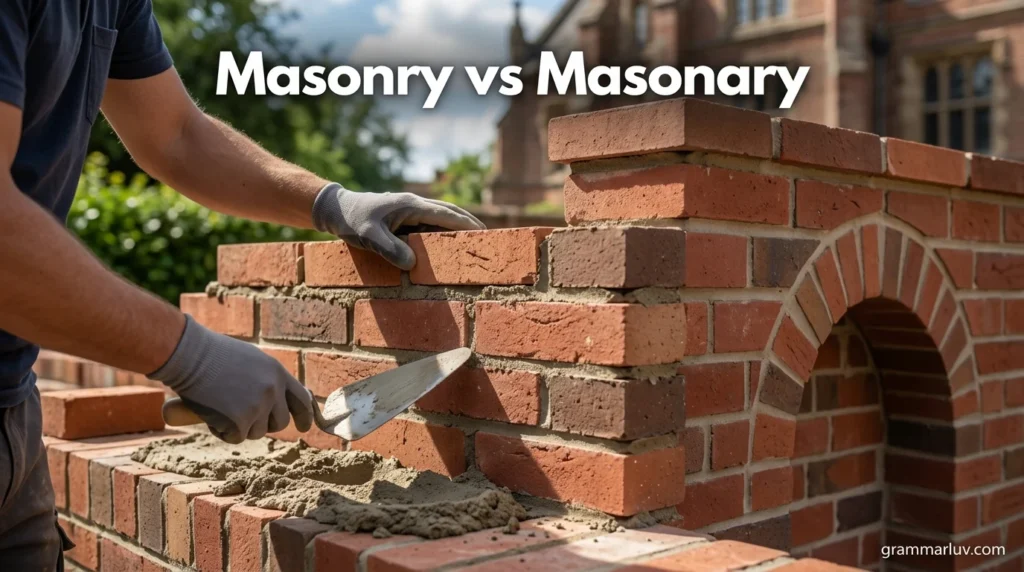
Introduction: Why Accurate Language Matters in Effective Writing
Strong communication depends on choosing the right words and spelling them correctly. Whether you’re writing an academic essay, a construction report, a creative story, or a professional email, accuracy helps readers understand your message clearly. At the same time, effective writing often relies on figurative language, descriptive language, literary devices, and poetic expression to make ideas more engaging and memorable.
Many English learners and writers encounter confusion when similar-looking words appear in writing. One common example is masonry vs masonary. Although these words look nearly identical, only one is considered correct in standard English. Understanding the difference can improve writing skills, support vocabulary enhancement, and prevent embarrassing spelling mistakes.
This comprehensive guide explains the correct spelling, meanings, usage examples, sentence structures, common errors, comparison charts, and practical exercises to help students and writers use the term confidently.
What Is Masonry?
Masonry is the correct English word.
It refers to:
- The craft or trade of building structures using materials such as brick, stone, concrete blocks, or similar units.
- Structures created through this building method.
- Stonework or brickwork collectively.
Dictionary Meaning
Masonry (noun):
The art, occupation, or work of constructing buildings from stone, brick, or concrete blocks.
Examples
- The historic church is famous for its beautiful masonry.
- Skilled masonry can last for centuries.
- The workers repaired the damaged masonry after the storm.
The word comes from the occupation of a mason, a person who works with stone, brick, or concrete materials.
What Is Masonary?
Masonary is generally considered a misspelling of masonry.
It appears frequently because people often assume that adding “-ary” to the word “mason” creates the correct noun form. However, English spelling does not follow that pattern in this case.
Incorrect Usage
❌ The building’s masonary was impressive.
Correct Usage
✅ The building’s masonry was impressive.
In formal writing, academic papers, professional communication, and construction-related documents, the spelling “masonary” should be avoided.
Quick Comparison Table
FeatureMasonryMasonaryCorrect spellingYesNoStandard English wordYesNoFound in dictionariesYesGenerally NoUsed in professional constructionYesNoSuitable for academic writingYesNoCommon misspellingNoYes
Why Do People Confuse These Words?
Several factors contribute to this common spelling mistake.
1. Pronunciation Similarity
When spoken quickly, the words may sound similar to many learners.
2. Influence of Other English Words
Many English words end with:
- -ary
- -ery
- -ory
Examples include:
- Library
- Dictionary
- Military
- Vocabulary
Because of these patterns, writers often assume “masonary” follows the same rule.
3. Typing Errors
Autocorrect does not always catch spelling mistakes immediately, especially when users repeatedly type the incorrect version.
4. Lack of Exposure
English learners may encounter the incorrect spelling online and mistakenly believe it is acceptable.
Understanding the Word “Mason”
To understand the correct spelling, it helps to understand the root word.
Mason
A mason is a skilled worker who builds with:
- Stone
- Brick
- Concrete blocks
- Marble
Examples
- The mason carefully restored the old wall.
- Skilled masons are essential in historical restoration projects.
- The mason used traditional techniques to preserve the structure.
Related Words
WordMeaningMasonWorker who builds with stone or brickMasonryThe craft or work itselfBricklayingLaying bricks in constructionStoneworkConstruction using stoneConstructionBuilding structures
Masonry in Construction and Architecture
Masonry remains one of the oldest and most reliable construction methods in the world.
Common Masonry Materials
- Brick
- Granite
- Limestone
- Marble
- Concrete blocks
- Sandstone
Benefits of Masonry
Durability
Masonry structures can survive for hundreds of years.
Fire Resistance
Brick and stone resist fire better than many other materials.
Energy Efficiency
Masonry walls often provide excellent insulation.
Low Maintenance
Properly built masonry requires relatively little upkeep.
Examples in Real Life
- Historic castles
- Stone bridges
- Brick homes
- Government buildings
- Religious structures
Using Masonry in Academic and Professional Writing
The word frequently appears in various forms of formal writing.
Academic Writing
- The researchers studied ancient masonry techniques.
- Roman masonry influenced architectural development throughout Europe.
Construction Reports
- Masonry repairs were completed during the second phase of the project.
- Engineers evaluated the condition of the exterior masonry.
Business Communication
- The company specializes in commercial masonry services.
- Masonry restoration increased the property’s value.
Technical Documents
- Masonry walls must comply with safety regulations.
- The report outlined recommended masonry improvements.
Sentence Examples for Better Understanding
Studying sentence examples helps improve writing skills and vocabulary retention.
Basic Sentences
- The masonry of the old building remained intact.
- Masonry requires patience and precision.
- Strong masonry increases structural stability.
Intermediate Sentences
- The architect admired the intricate masonry surrounding the cathedral entrance.
- Traditional masonry techniques continue to influence modern construction.
- Weather conditions can affect exterior masonry over time.
Advanced Sentences
- The preservation team implemented specialized masonry restoration methods to maintain the historical authenticity of the monument.
- Exceptional masonry craftsmanship transformed ordinary materials into a masterpiece of architectural beauty.
Figurative Language and Creative Writing Examples
Although masonry is primarily a construction term, writers often use it in figurative language and creative writing.
Metaphor Examples
A metaphor directly compares two things without using “like” or “as.”
Examples
- Trust is the masonry of a strong relationship.
- Discipline is the masonry that supports success.
Simile Examples
A simile uses “like” or “as.”
Examples
- His determination was as solid as masonry.
- Their friendship stood like ancient masonry against every challenge.
Personification
Examples
- The old masonry whispered stories from centuries past.
- The weathered walls proudly displayed their masonry scars.
Symbolism
Masonry can symbolize:
- Strength
- Stability
- Endurance
- Tradition
- Protection
Literary Devices and Poetic Expression Using Masonry
Writers often incorporate construction imagery into descriptive language.
Imagery Example
The golden sunlight danced across the weathered masonry, revealing patterns carved by generations of wind and rain.
Alliteration Example
Massive masonry monuments marked the mountain path.
Symbolic Writing Example
The castle’s masonry represented the resilience of an entire civilization.
Poetic Expression Example
Beneath the moonlit sky, ancient masonry stood as a silent witness to history’s passage.
Such examples enrich creative writing and make descriptions more vivid.
Tone Usage: When Masonry Fits Different Writing Styles
The word can be adapted to different tones.
ToneExampleFormalThe masonry exhibited exceptional structural integrity.AcademicResearchers analyzed medieval masonry techniques.ProfessionalMasonry restoration was completed ahead of schedule.CreativeThe ancient masonry guarded forgotten secrets.DescriptiveCracked masonry reflected decades of weather exposure.
Understanding tone usage helps writers communicate appropriately in different contexts.
Avoid Masonry When
❌ Referring to a mason (the worker)
Incorrect:
- The masonry built the wall.
Correct:
- The mason built the wall.
❌ Using the misspelled form
Incorrect:
- The masonary was beautiful.
Correct:
- The masonry was beautiful.
Common Mistakes and How to Avoid Them
Mistake 1: Writing “Masonary”
Incorrect:
- The masonary was damaged.
Correct:
- The masonry was damaged.
Mistake 2: Confusing Mason and Masonry
Incorrect:
- The masonry repaired the chimney.
Correct:
- The mason repaired the chimney.
Mistake 3: Using It as a Verb
Incorrect:
- They masonry the wall.
Correct:
- They built the wall using masonry techniques.
Memory Trick
Remember:
Mason → Masonry
There is no extra “a” before the final “ry.”
Practice Exercises for Students and English Learners
Exercise 1: Choose the Correct Word
- The building’s _____ required restoration.
- a) masonary
- b) masonry
Answer: b) masonry
- The skilled _____ repaired the wall.
- a) mason
- b) masonry
Answer: a) mason
Exercise 2: Correct the Sentence
Incorrect:
- The old masonary survived the earthquake.
Correct:
- The old masonry survived the earthquake.
Exercise 3: Create Your Own Sentence
Write a sentence using:
- Masonry
- Mason
- Stonework
Example:
The mason carefully repaired the historic masonry and preserved the original stonework.
Vocabulary Enhancement: Related Words and Synonyms
Related Construction Terms
WordMeaningBrickworkConstruction using bricksStoneworkConstruction using stoneConstructionBuilding processArchitectureDesign of structuresRestorationRepairing historical buildingsFoundationStructural baseCraftsmanshipSkilled workmanshipEngineeringTechnical design and construction
Learning related vocabulary strengthens both reading comprehension and writing ability.
FAQs
1. Is “masonary” ever correct?
No. In standard English, “masonary” is considered a misspelling. The correct word is “masonry.”
2. What does masonry mean?
It refers to the craft, work, or structures made from brick, stone, concrete blocks, or similar materials.
3. What is a mason?
A mason is a skilled worker who builds or repairs structures using stone, brick, or related materials.
4. Why do people spell masonry incorrectly?
The mistake often occurs because of pronunciation similarities and confusion with other English words ending in “-ary.”
5. Can masonry be used in creative writing?
Yes. Writers frequently use it in metaphors, similes, symbolism, imagery, and other literary devices to represent strength, stability, and endurance.
Final Thoughts
Understanding the distinction between masonry vs masonary helps writers, students, and English learners improve spelling accuracy and communicate more effectively. “Masonry” is the only correct standard English spelling and refers to the craft or structure built from materials such as brick and stone. “Masonary” is simply a common misspelling that should be avoided in professional, academic, and everyday writing.
Beyond mastering the spelling, learning how to use the term in descriptive language, creative writing, figurative language, literary devices, metaphors, similes, and academic contexts can significantly enhance writing skills. By practicing sentence construction, studying comparison examples, and understanding common mistakes, learners can confidently use the word while expanding their vocabulary and overall communication abilities.