
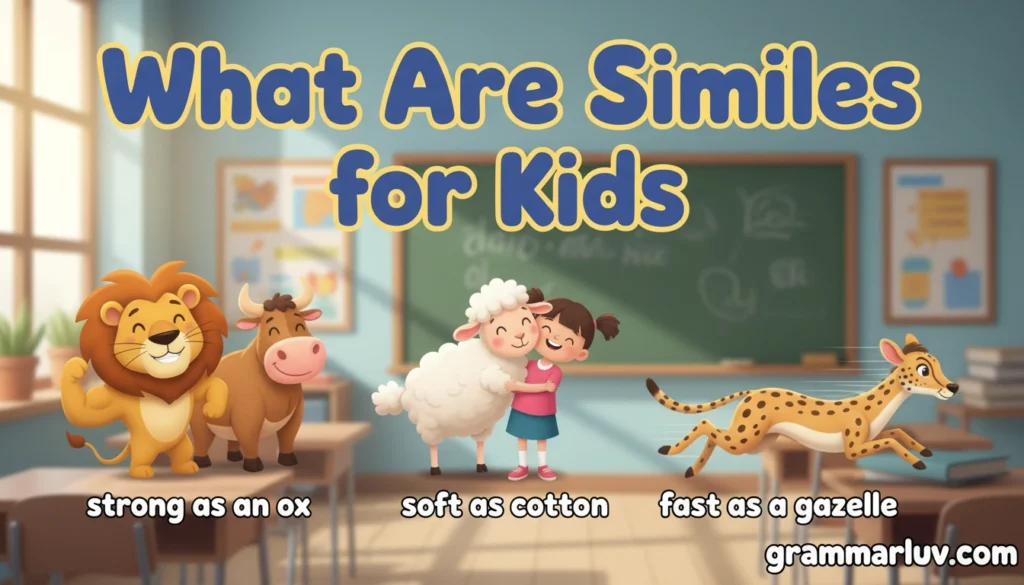
Similes are one of the easiest and most fun ways for kids to make their writing lively and expressive. But what are similes for kids, exactly? A simile is a figure of speech that compares two different things using words like “like” or “as”. Think of it as a magic trick for words: you take something ordinary and make it extraordinary by showing a vivid comparison. Similes are everywhere—in books, movies, songs, and even everyday conversations. They make writing interesting, help readers visualize ideas, and make your descriptions unforgettable.
If you also want to understand how similes are different from metaphors, read our complete guide on Similes and Metaphors for Kids to make learning even easier.
For children, learning similes is not just about grammar; it’s about imagination. Using similes in stories, essays, or even texting can bring emotions, humor, and creativity to life. This guide introduces 25 simple yet powerful similes that kids can use in daily writing. Each one includes meaning, tone, context, and examples to help young writers understand and apply them naturally.
Busy as a Bee
Meaning: Refers to someone who is very active or constantly doing something.
Tone: Light, positive, and energetic.
Best Usage: When describing someone’s work habits, playfulness, or hectic activity.
Examples:
- Emma was busy as a bee, cleaning her room before the guests arrived.
- The little ants were busy as bees, carrying food back to their hill.
- My brother is busy as a bee finishing his homework and helping with chores at the same time.
Daily-use tip: You can say, “I’ve been busy as a bee all day!” when texting a friend about your day.
Quiet as a Mouse
Meaning: Extremely quiet or soft-spoken.
Tone: Gentle, calm, sometimes secretive.
Best Usage: To describe someone sneaking around or a quiet moment.
Examples:
- Lily tiptoed quiet as a mouse so she wouldn’t wake her baby brother.
- During the movie, everyone sat quiet as a mouse.
- The kitten crept quiet as a mouse across the carpet.
Daily-use tip: When you want your sibling to lower the volume, you can jokingly say, “Be quiet as a mouse!”
Light as a Feather
Meaning: Very light in weight.
Tone: Soft, delicate, uplifting.
Best Usage: When describing something physically light or gentle in movement.
Examples:
- The baby bird felt light as a feather in my hand.
- Her dress floated around her light as a feather.
- The balloon drifted light as a feather into the sky.
Daily-use tip: Use this simile in crafts or games: “This paper airplane is light as a feather; it will fly far!”
Happy as a Clam
Meaning: Extremely happy or content.
Tone: Cheerful, joyful.
Best Usage: Describing someone who feels very pleased, comfortable, or safe.
Examples:
- Max was happy as a clam when he got an A on his test.
- The dog rolled in the grass, happy as a clam.
- After finishing her ice cream, Sarah looked happy as a clam.
Daily-use tip: Text a friend: “Just got my favorite game—happy as a clam!”
Brave as a Lion
Meaning: Very courageous and fearless.
Tone: Bold, inspiring.
Best Usage: To describe acts of bravery or determination.
Examples:
- Jack was brave as a lion when he stood up to the bully.
- The firefighter entered the burning house, brave as a lion.
- She felt brave as a lion trying out for the school play.
Daily-use tip: Encourage a friend: “You’ll be brave as a lion in your presentation!”
Sweet as Honey
Meaning: Very sweet or kind in behavior.
Tone: Warm, friendly, affectionate.
Best Usage: To describe people, gestures, or even food.
Examples:
- Grandma gave me a hug that was sweet as honey.
- That puppy is sweet as honey when it wags its tail.
- Lily’s words were sweet as honey to cheer me up.
Daily-use tip: Compliment a friend: “You’re sweet as honey for helping me.”
Fast as Lightning
Meaning: Extremely fast.
Tone: Exciting, energetic, dramatic.
Best Usage: For describing speed, action, or quick thinking.
Examples:
- The cheetah ran fast as lightning across the savannah.
- Tim finished his homework fast as lightning.
- The car zoomed past, fast as lightning.
Daily-use tip: Use in gaming: “I dodged the obstacle fast as lightning!”
Stubborn as a Mule
Meaning: Extremely determined and unwilling to change one’s mind.
Tone: Humorous or lightly critical.
Best Usage: Describing children, pets, or anyone resistant to persuasion.
Examples:
- My little brother was stubborn as a mule about eating vegetables.
- The donkey stood stubborn as a mule, refusing to move.
- She was stubborn as a mule, insisting she was right.
Daily-use tip: Say playfully: “Don’t be stubborn as a mule—try it once!”
Blind as a Bat
Meaning: Having very poor eyesight or not noticing something obvious.
Tone: Funny, lighthearted.
Best Usage: When teasing someone or describing something invisible to the eyes.
Examples:
- I was blind as a bat without my glasses.
- He missed the obvious sign, blind as a bat.
- The cat stumbled in the dark, blind as a bat.
Daily-use tip: Use in texting jokes: “Without coffee, I’m blind as a bat this morning.”
Gentle as a Lamb
Meaning: Very kind, gentle, or innocent.
Tone: Soft, caring, tender.
Best Usage: To describe children, pets, or anyone with a gentle nature.
Examples:
- The baby was gentle as a lamb while touching the kitten.
- She spoke gentle as a lamb to calm the crying toddler.
- His touch was gentle as a lamb on the fragile plant.
Daily-use tip: Compliment someone’s kind action: “You handled that gentle as a lamb—well done!”
Hungry as a Wolf
Meaning: Extremely hungry.
Tone: Dramatic, exaggerated, fun.
Best Usage: Talking about food cravings, appetite, or mealtime excitement.
Examples:
- After soccer practice, I was hungry as a wolf.
- The kids were hungry as wolves after the long trip.
- He finished the pizza, hungry as a wolf.
Daily-use tip: Say before lunch: “I’m hungry as a wolf—let’s eat!”
Busy as a Beaver
Meaning: Hardworking, always doing something.
Tone: Positive, industrious.
Best Usage: Describing someone putting effort into a project or activity.
Examples:
- She’s been busy as a beaver building her model.
- The students worked busy as beavers to finish the project.
- Dad was busy as a beaver fixing the broken fence.
Daily-use tip: Use in class: “I’ve been busy as a beaver with homework all day!”
Sharp as a Needle
Meaning: Very sharp or keen.
Tone: Precise, sometimes painful or literal.
Best Usage: For objects, minds, or senses that are very sharp.
Examples:
- The pencil was sharp as a needle.
- Her memory was sharp as a needle; she remembered everything.
- Watch out, the knife is sharp as a needle!
Daily-use tip: Compliment intelligence: “Your observation was sharp as a needle!”
Cool as a Cucumber
Meaning: Very calm under pressure.
Tone: Relaxed, composed.
Best Usage: Describing people in stressful situations or making jokes about calmness.
Examples:
- Despite the chaos, Mom remained cool as a cucumber.
- He answered the tricky question cool as a cucumber.
- The cat sat cool as a cucumber while the dog barked.
Daily-use tip: Reassure a friend: “Stay cool as a cucumber, you’ll do great!”
Bright as the Sun
Meaning: Very bright, cheerful, or intelligent.
Tone: Warm, positive.
Best Usage: Describing personality, light, or mood.
Examples:
- Her smile was bright as the sun.
- The classroom was bright as the sun after the lights turned on.
- He is bright as the sun when solving puzzles.
Daily-use tip: Text a friend compliment: “Your idea is bright as the sun!”
Looking for more simple and fun examples? Explore our collection of Common Similes for Kids that children can easily understand and use in school.
Sleepy as a Log
Meaning: Extremely sleepy.
Tone: Relaxed, humorous.
Best Usage: Talking about tiredness, naps, or bedtime.
Examples:
- After the long hike, I was sleepy as a log.
- The baby fell sleepy as a log in his crib.
- He was sleepy as a log during the long movie.
Daily-use tip: Say at bedtime: “I’m sleepy as a log—goodnight!”
Sweet as Sugar
Meaning: Very kind, delightful, or literally sweet.
Tone: Warm, affectionate. Best Usage: Complimenting people, food, or gestures.
Examples:
- Grandma’s cookies are sweet as sugar.
- My friend’s words were sweet as sugar.
- The puppy’s behavior is sweet as sugar.
Daily-use tip: Text: “You’re sweet as sugar for helping me!”
Strong as an Ox
Meaning: Very strong physically or mentally.
Tone: Powerful, impressive. Best Usage: Describing strength, stamina, or determination.
Examples:
- Dad is strong as an ox when lifting heavy boxes.
- She is strong as an ox after practicing martial arts.
- The bridge was strong as an ox and held the weight easily.
Daily-use tip: Motivate a friend: “You’ll be strong as an ox after practice!”
Bright-eyed as a Newborn
Meaning: Excited, curious, and full of wonder.
Tone: Innocent, joyful. Best Usage: Describing children, pets, or excited people.
Examples:
- The baby looked bright-eyed as a newborn exploring the garden.
- The puppy was bright-eyed as a newborn, discovering new toys.
- Lily was bright-eyed as a newborn on her first day at school.
Daily-use tip: Say about a friend starting a new hobby: “You’re bright-eyed as a newborn learning piano!”
Free as a Bird
Meaning: Completely free or unrestricted.
Tone: Liberating, joyful. Best Usage: Describing feelings, vacations, or adventures.
Examples:
- On summer break, I felt free as a bird.
- The kite flew free as a bird in the sky.
- He ran free as a bird in the open field.
Daily-use tip: Express happiness: “Finally done with exams—free as a bird!”
Clever as a Fox
Meaning: Very smart, clever, or tricky.
Tone: Playful, intelligent. Best Usage: Describing problem-solving, tricks, or clever plans.
Examples:
- Sam was clever as a fox finding the missing toy.
- She solved the puzzle clever as a fox.
- The raccoon sneaked food, clever as a fox.
Daily-use tip: Praise a friend’s strategy: “You’re clever as a fox for figuring it out!”
Quiet as a Whisper
Meaning: Extremely quiet, almost inaudible.
Tone: Gentle, secretive. Best Usage: To describe silence, secrets, or soft actions.
Examples:
- The wind blew quiet as a whisper.
- She spoke quiet as a whisper so no one could hear.
- The mouse moved quiet as a whisper across the floor.
Daily-use tip: Say while sneaking: “Step quiet as a whisper so Mom doesn’t wake up.”
Bright as a Star
Meaning: Shining, brilliant, or outstanding.
Tone: Inspirational, cheerful. Best Usage: Describing people, achievements, or objects that stand out.
Examples:
- Her performance was bright as a star on stage.
- The flashlight was bright as a star in the dark room.
- He is bright as a star in solving math problems.
Daily-use tip: Encourage a friend: “You’ll shine bright as a star in your show!”
Strong-willed as a Tiger
Meaning: Determined and unyielding.
Tone: Bold, confident. Best Usage: To describe strong determination in people or characters.
Examples:
- Sarah was strong-willed as a tiger, refusing to quit.
- The child, strong-willed as a tiger, insisted on finishing the game.
- He was strong-willed as a tiger, standing up for his friends.
Daily-use tip: Motivate yourself: “Be strong-willed as a tiger and never give up!”
Cool-headed as Ice
Meaning: Calm and composed, especially in stressful situations.
Tone: Rational, composed, positive. Best Usage: Describing reactions, decisions, or strategic thinking.
Examples:
- During the fire drill, the teacher stayed cool-headed as ice.
- He solved the argument cool-headed as ice.
- Mom remained cool-headed as ice while the kids argued.
Daily-use tip: Encourage calmness: “Stay cool-headed as ice, we can fix this.”
FAQs
What Are Similes for Kids?
Similes for kids are comparisons using “like” or “as” to make descriptions fun, vivid, and easy to understand. They help children express emotions, actions, and objects in creative ways.
Why Are Similes Important for Children?
Similes improve imagination, writing skills, and communication. They make stories colorful, enhance reading comprehension, and help kids relate ideas to familiar experiences.
How Can Kids Remember Similes Easily?
Kids can remember similes by linking them to images, daily experiences, and favorite animals or objects. Practicing in stories, homework, and texting helps too.
Can Similes Be Used in Everyday Conversations?
Yes! Kids can use similes in texts, casual talks, or describing their feelings. Examples include “I’m hungry as a wolf” or “Happy as a clam!”
Are There Any Fun Games to Teach Similes?
Yes! Try matching games, storytelling challenges, or simile charades. Encourage kids to invent their own similes for objects around them.
How Do Similes Help in School Writing?
Similes make essays, stories, and reports more engaging and descriptive. Teachers often reward creative comparisons that show imagination and understanding.
Can Similes Be Used for Digital Content?
Absolutely! Kids can use similes in blogs, social media posts, or videos to make descriptions lively and relatable. For example: “Fast as lightning in the game!”
Now that you understand what similes are, you can practice with even more fun comparisons in our full list of Common Similes for Kids.
Conclusion
Similes are magical tools that bring words to life. They help kids describe the world with color, humor, and emotion. By using similes, children learn to think creatively, communicate clearly, and make everyday writing exciting. From busy as a bee to cool-headed as ice, each simile adds sparkle and personality. Encourage kids to spot similes around them, create their own, and use them in daily writing or speech. This simple habit can transform ordinary sentences into vivid stories that leave readers smiling, imagining, and remembering every word.