
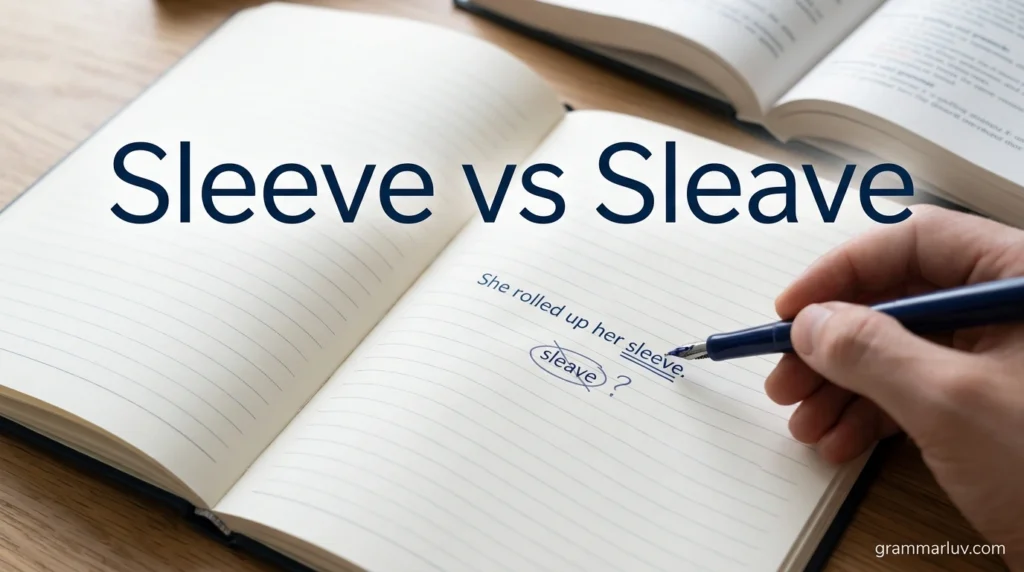
Introduction: Why Figurative Language Improves Writing and Communication
Strong writing depends on precision, clarity, and the ability to choose the right words. Whether you are a student, writer, or English learner, understanding vocabulary differences helps you communicate effectively. Figurative language, descriptive language, simile examples, metaphor examples, and poetic expression enrich communication by making ideas vivid and memorable.
Many English learners become confused by words that look or sound similar. One such confusion involves sleeve and sleave. Although they differ by only one letter, they have completely different meanings and levels of usage. Understanding these words strengthens writing skills, improves vocabulary enhancement, and prevents common spelling mistakes.
This guide explains meanings, comparison examples, sentence examples, literary devices, idiom meaning, tone usage, and practical exercises to help you master these terms.
What Does “Sleeve” Mean?
Sleeve is a common noun referring to the part of a garment that covers the arm. It may also appear in many figurative expressions and technical contexts.
Basic Definition
A sleeve is:
- The arm portion of a shirt, jacket, or dress.
- A protective covering.
- A container or wrapper for documents, records, or electronics.
Examples
- She rolled up her sleeves before beginning the project.
- The jacket has long sleeves.
- Place the document in a plastic sleeve.
Because it is widely used in everyday English, “sleeve” appears frequently in both formal and informal writing.
What Does “Sleave” Mean?
Sleave is an uncommon and archaic word. Historically, it refers to:
- Fine untwisted silk or thread.
- Something delicate and loosely spun.
Modern English speakers rarely use this word except when studying literature or reading older texts.
Examples
- The poet described the fabric as a delicate sleave.
- Scholars encounter the word mainly in historical texts.
Most people will never need to use “sleave” in ordinary communication.
Quick Comparison Table
| Feature | Sleeve | Sleave |
| Part of Speech | Noun | Noun |
| Common Usage | Very common | Rare and archaic |
| Meaning | Part of clothing covering the arm | Fine silk thread |
| Modern English | Frequently used | Rarely used |
| Formal Writing | Yes | Rarely |
| Everyday Conversation | Yes | Almost never |
| Literary Texts | Sometimes | Mainly |
Origin and Etymology of Both Words
Understanding word origins improves vocabulary enhancement and writing skills.
Sleeve
Derived from Old English sliefe, the word has been used for centuries to describe the arm covering of garments.
Sleave
The term comes from Middle English and was associated with silk fibers or untwisted thread. Its use gradually declined and became largely literary.
This difference explains why “sleeve” is familiar while “sleave” appears unusual.
Comparison Examples: Understanding the Difference
These comparison examples make the distinction easier.
| Correct Usage | Explanation |
| She folded the sleeve of her shirt. | Refers to clothing. |
| He placed the CD inside a protective sleeve. | Means covering. |
| The ancient text mentioned a sleave of silk. | Literary usage. |
| The tailor repaired the sleeve. | Everyday meaning. |
Incorrect Example
❌ She rolled up her sleaves.
Correct Version
✅ She rolled up her sleeves.
Remember:
- Sleeve = clothing or covering
- Sleave = fine thread, archaic term
Sentence Examples in Different Contexts
Sentence examples help learners understand proper usage.
Everyday English
- His shirt sleeve was torn.
- She wore a dress with lace sleeves.
- The mechanic rolled up his sleeves.
Professional Writing
- Insert the certificate into a plastic sleeve.
- Protective sleeves prevent damage to documents.
Literary Context
- The manuscript referred to a delicate sleave of silk.
- The ancient description mentioned threads of sleave.
Academic Writing
- Vocabulary confusion often occurs between similar-looking words.
- Accurate spelling improves communication.
Idioms and Expressions Involving “Sleeve”
English contains many idioms featuring this word.
Wear Your Heart on Your Sleeve
Meaning: To express emotions openly.
Example
- Sarah wears her heart on her sleeve and rarely hides her feelings.
Have Something Up Your Sleeve
Meaning: To have a secret plan.
Example
- The coach has another strategy up his sleeve.
Roll Up Your Sleeves
Meaning: Prepare to work hard.
Example
- It’s time to roll up our sleeves and finish the project.
These idioms add figurative language and enrich creative writing.
Figurative Language and Literary Devices Using Sleeve
Writers often use words symbolically. Literary devices help create vivid imagery and emotional impact.
Metaphor Examples
- Success is hidden up your sleeve.
- Hope rolled up its sleeves and got to work.
Simile Examples
- Her confidence spread like a neatly pressed sleeve.
- He stood straight as a tailored sleeve.
Personification
- The old coat’s sleeves embraced memories.
Symbolism
Sleeves may symbolize:
- Preparation
- Protection
- Hard work
- Readiness
Such descriptive language enhances poetic expression and storytelling.
Tone Usage in Writing and Communication
Understanding tone usage helps writers choose words appropriately.
Formal Tone
Suitable examples:
- Protective sleeve
- Document sleeve
- Shirt sleeve
Informal Tone
Common expressions:
- Roll up your sleeves.
- Wear your heart on your sleeve.
Literary Tone
Rare contexts may use “sleave”:
- Historical fiction
- Poetry
- Classical literature
Creative Writing
Authors may employ figurative language to create atmosphere and emotional depth.
Example:
He rolled up his sleeves, ready to wrestle with destiny itself.
When to Avoid Using “Sleave”
Avoid “sleave” in:
Business Writing
Incorrect:
- Put the paper in a sleave.
Correct:
- Put the paper in a sleeve.
Academic Essays
Using rare words unnecessarily may confuse readers.
Everyday Conversation
Most native speakers do not use “sleave.”
Technical Writing
Clarity is more important than obscure vocabulary.
Simple and familiar language improves communication.
Common Mistakes and How to Avoid Them
Mistake 1: Spelling “Sleeve” as “Sleave”
❌ shirt sleave
✅ shirt sleeve
Mistake 2: Using “Sleave” in Everyday Context
❌ Put the photo in a sleave.
✅ Put the photo in a sleeve.
Mistake 3: Assuming Both Words Are Interchangeable
They have different meanings and should not replace one another.
Memory Trick
Think:
Sleeve contains “ee,” just like “see.”
You can easily see the sleeve on your shirt.
Creative Writing Applications
Creative writers use descriptive language and literary devices to make scenes memorable.
Example with Imagery
The wind tugged gently at the sleeves of his coat as autumn leaves danced along the empty street.
Example with Metaphor
Determination rolled up its sleeves and faced the impossible.
Example with Personification
The worn sleeves carried years of memories.
Example with Poetic Expression
Moonlight rested softly upon the silver sleeves of her gown.
Such writing techniques enhance storytelling and emotional impact.
Practice Exercises for Students and English Learners
Exercise 1: Fill in the Blank
- She rolled up her ______ before washing the car.
- Place the photograph inside a protective ______.
- Ancient texts occasionally mention ______ made from silk.
Answers
- sleeves
- sleeve
- sleave
Exercise 2: Identify Correct Usage
A. He rolled up his sleaves.
B. He rolled up his sleeves.
✅ Correct answer: B
Exercise 3: Choose the Appropriate Word
- The tailor repaired the (sleeve/sleave).
- Historians studied references to silk (sleeves/sleave).
- The player had another trick up his (sleeve/sleave).
Answers
- sleeve
- sleave
- sleeve
Summary Comparison Table
| Aspect | Sleeve | Sleave |
| Frequency | High | Very Low |
| Modern Usage | Common | Rare |
| Everyday Speech | Yes | No |
| Literature | Sometimes | Mainly |
| Meaning | Arm covering or protective case | Fine thread |
| Recommended for Learners | Yes | Rarely |
| Business Writing | Yes | No |
| Creative Writing | Yes | Occasionally |
FAQs
1. Is “sleave” a real English word?
Yes. It is an old and uncommon English word referring to fine silk thread.
2. Which spelling is correct for clothing?
” Sleeve” is the correct spelling when referring to the arm portion of a garment.
3. Can “sleave” replace “sleeve”?
No. They have different meanings and are not interchangeable.
4. Why do people confuse these words?
Their pronunciation and spelling are similar, causing spelling errors among learners.
5. Should English learners memorize “sleave”?
Not necessarily. Since it is rarely used, learners should focus mainly on mastering “sleeve.”
Conclusion
Although “sleeve” and “sleave” differ by only one letter, they belong to entirely different worlds of English vocabulary. Sleeve is an essential everyday word used in clothing, idioms, professional communication, and figurative language. Sleave, by contrast, survives mostly in historical and literary contexts.
Learning these distinctions strengthens writing skills, supports vocabulary enhancement, and improves clarity in communication. Whether you’re practicing descriptive language, studying literary devices, exploring metaphor examples and simile examples, or refining creative writing, understanding precise word choice allows your message to become clearer, richer, and more effective.