
Introduction: Why Figurative Language and Precise Word Choice Matter
Good writing is more than correct grammar. It involves choosing the most accurate words to communicate ideas clearly and effectively. Whether you are writing essays, stories, poems, emails, or academic assignments, precise vocabulary helps readers understand exactly what you mean.
Figurative language, descriptive language, literary devices, similes, metaphors, and idioms all become more powerful when paired with the right word choices. Many English learners struggle with verbs related to vision because they appear similar but have different meanings and uses.
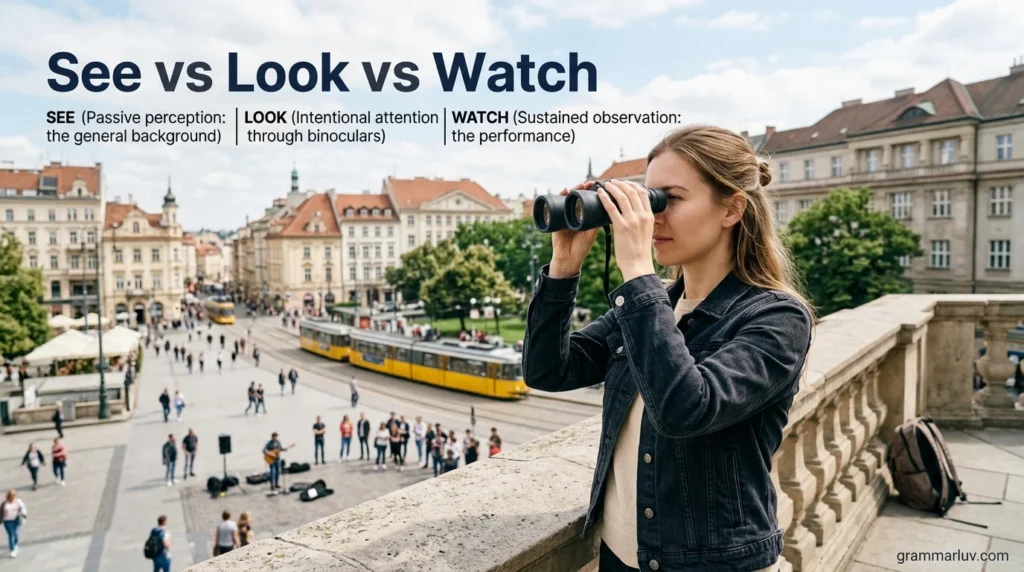
Among the most commonly confused verbs are see vs look vs watch. While all three relate to using your eyes, each describes a different type of visual experience. Understanding these differences can significantly improve your writing skills, vocabulary enhancement, speaking confidence, and communication effectiveness.
This guide explains the meaning of each word, when to use it, when to avoid it, common mistakes, comparison examples, figurative uses, sentence examples, and practical exercises.
Understanding the Basic Difference
The easiest way to remember these verbs is to think about the level of attention involved.
| Word | Meaning | Attention Level | Duration |
| See | Notice with your eyes naturally | Low | Usually brief |
| Look | Direct your eyes intentionally | Medium | Short |
| Watch | Observe carefully over time | High | Long |
Quick Example
- I saw a bird outside my window.
- I looked at the bird.
- I watched the bird fly away.
The first action is automatic, the second is intentional, and the third involves sustained attention.
What Does “See” Mean?
“See” refers to noticing something with your eyes without making a special effort.
It is the most passive of the three verbs.
Characteristics of See
- Natural visual perception
- No deliberate action required
- Can mean understand or realize
- Common in everyday conversation
Sentence Examples
- I can see the mountains from here.
- She saw a rainbow after the storm.
- We saw an unusual animal in the forest.
- Did you see the message I sent?
- They saw smoke coming from the building.
See as Understanding
“See” often has a figurative meaning.
Examples:
- I see your point.
- Now I see the problem.
- Do you see what I mean?
In these examples, “see” means understand rather than physically observe.
When to Use See
Use “see” when:
- Something enters your vision naturally.
- You become aware of something visually.
- You mean understand or realize.
When Not to Use See
Incorrect:
- I saw at the painting.
Correct:
- I looked at the painting.
What Does “Look” Mean?
“Look” means directing your eyes toward something intentionally.
Unlike “see,” it requires conscious effort.
Characteristics of Look
- Intentional action
- Focused attention
- Often followed by “at”
- Usually brief
Sentence Examples
- Look at this picture.
- She looked at the map carefully.
- Please look at the board.
- He looked around the room.
- They looked for their lost keys.
Common Expressions with Look
Look At
- Look at the stars.
- Look at these examples.
When to Use Look
Use “look” when:
- You intentionally focus your eyes.
- You want someone to notice something.
- You are searching for something.
What Does “Watch” Mean?
“Watch” means observing something carefully for a period of time.
It often involves movement, action, or change.
Characteristics of Watch
- Continuous observation
- Active attention
- Usually involves motion
- Takes time
Sentence Examples
- We watched a movie last night.
- She watched the children play.
- I watched the sunset.
- They watched the football match.
- He watched the birds flying overhead.
When to Use Watch
Use “watch” when:
- Something is moving.
- An activity continues over time.
- You are paying close attention.
When Not to Use Watch
Incorrect:
- Watch this photograph.
Correct:
- Look at this photograph.
A photograph is generally static, so “look at” is more appropriate.
Quick Comparison Table
| Situation | Correct Verb |
| Notice a bird suddenly | See |
| Examine a painting | Look |
| Observe a football game | Watch |
| Understand an explanation | See |
| Search for your keys | Look |
| Observe children playing | Watch |
See, Look, and Watch in Creative Writing
Writers often choose these verbs carefully to create different effects.
Using See
Creates awareness or discovery.
Example:
- She saw a shadow move across the wall.
Using Look
Creates intentional focus.
Example:
- He looked closely at the mysterious letter.
Using Watch
Creates suspense and prolonged observation.
Example:
- They watched the storm approach from the horizon.
These subtle differences help writers improve storytelling and descriptive language.
Figurative Language and Literary Devices
These verbs frequently appear in figurative language and literary devices.
Metaphor Examples
- She watched her dreams fade away.
- He saw opportunity in every challenge.
Simile Examples
- She watched the river flow like liquid silver.
- He looked at the stars like a curious child.
Personification Examples
- The moon watched over the sleeping village.
- The mountains looked down upon the valley.
Symbolic Usage
Authors often use vision-related verbs symbolically.
Examples:
- Seeing may represent understanding.
- Looking may represent searching.
- Watching may represent patience or anticipation.
Common Idioms and Their Meanings
See Eye to Eye
Meaning: Agree completely.
Example:
- The managers finally saw eye to eye.
See the Light
Meaning: Understand something.
Example:
- She finally saw the light after the explanation.
Look Before You Leap
Meaning: Think carefully before acting.
Example:
- Always look before you leap when making important decisions.
Look Down On
Meaning: Consider someone inferior.
Example:
- Nobody should look down on others.
Watch Your Step
Meaning: Be careful.
Example:
- Watch your step on the slippery floor.
Watch Out
Meaning: Be cautious.
Example:
- Watch out for traffic when crossing the street.
Common Mistakes English Learners Make
Mistake 1: Using See Instead of Look
Incorrect:
- See this picture.
Correct:
- Look at this picture.
Mistake 2: Using Look Instead of Watch
Incorrect:
- We looked a movie.
Correct:
- We watched a movie.
Mistake 3: Using Watch for Static Objects
Incorrect:
- Watch this photograph.
Correct:
- Look at this photograph.
Mistake 4: Forgetting “At”
Incorrect:
- Look the painting.
Correct:
- Look at the painting.
Tone and Context Usage
Different verbs can influence tone.
See
Tone: Natural, casual, observational
Example:
- I saw your message yesterday.
Look
Tone: Intentional, instructional
Example:
- Look at this evidence carefully.
Watch
Tone: Attentive, engaged
Example:
- Watch how the experiment changes.
Selecting the right verb helps make communication clearer and more professional.
Vocabulary Enhancement Through Related Words
Expanding your vocabulary improves writing quality.
Synonyms of See
- Notice
- Observe
- Detect
- Recognize
- Perceive
Using varied vocabulary makes writing more engaging and sophisticated.
Real-Life Examples
At School
- I saw my teacher in the hallway.
- I looked at the assignment instructions.
- I watched the science demonstration.
At Home
- She saw a spider on the wall.
- He looked at the family photo album.
- We watched television together.
While Traveling
- They saw beautiful mountains.
- She looked at the map.
- We watched dolphins swimming nearby.
Practice Exercises
Choose the correct word: see, look, or watch.
Exercise 1
- Can you _____ the airplane in the sky?
- Please _____ at page ten.
- We _____ a documentary last night.
- I can _____ your point now.
- They _____ the children playing outside.
Answers
- See
- Look
- Watched
- See
- Watched
Exercise 2
Correct the mistakes.
- Watch this photograph.
- I looked a movie yesterday.
- See at the board.
Correct Answers
- Look at this photograph.
- I watched a movie yesterday.
- Look at the board.
When to Use and When to Avoid Each Word
| Word | Use When | Avoid When |
| See | Noticing naturally or understanding | Intentional observation |
| Look | Directing attention intentionally | Long-term observation |
| Watch | Observing movement over time | Static objects |
FAQs
1. What is the main difference between see, look, and watch?
“See” is passive, “look” is intentional, and “watch” involves continuous observation.
2. Why do we watch television but look at pictures?
Television involves movement and ongoing action, while pictures are static.
3. Can “see” mean understand?
Yes. Expressions such as “I see your point” use “see” to mean understand.
4. Do we say “look a movie” or “watch a movie”?
The correct phrase is “watch a movie.”
5. Which verb is best for academic writing?
All three are useful, but the correct choice depends on context. Precision is more important than complexity.
Conclusion
Understanding the differences between see, look, and watch is essential for clear communication and effective writing. Although these verbs all relate to vision, they describe different levels of attention and observation. “See” refers to natural perception, “look” involves deliberate focus, and “watch” describes sustained observation over time.
Mastering these distinctions improves writing skills, vocabulary enhancement, creative writing, descriptive language, figurative expression, and everyday conversation. By practicing the examples, avoiding common mistakes, and applying the comparison rules discussed in this guide, students, writers, and English learners can use these verbs confidently and accurately in any situation.