
Introduction: Why Figurative Language and Strong Grammar Matter
Great writing is built on two foundations: creativity and grammar. Writers use figurative language, descriptive language, literary devices, simile examples, metaphor examples, and poetic expression to make their work engaging and memorable. However, even the most creative sentences need proper grammatical structure to communicate ideas clearly.
One area that often confuses students and English learners is understanding how different types of verbs function within a sentence. Among the most commonly misunderstood are copula verbs and auxiliary verbs. While both frequently involve forms of the verb “be,” they serve entirely different purposes.
Learning the distinction helps improve writing skills, vocabulary enhancement, sentence construction, and overall communication. Whether you’re writing essays, stories, business emails, or creative writing pieces, knowing how these verbs work can make your English more accurate and effective.
This guide explains their meanings, functions, usage rules, comparison examples, common mistakes, exercises, and practical applications.
What Are Verbs?
Before exploring specific verb types, let’s review what a verb is.
A verb is a word that expresses:
- An action
- A state of being
- An occurrence
Examples
| Sentence | Verb |
| She runs every morning. | runs |
| They laughed loudly. | laughed |
| The soup tastes delicious. | tastes |
| He is happy. | is |
Verbs are essential because every complete sentence typically requires one.
What Are Copula Verbs?
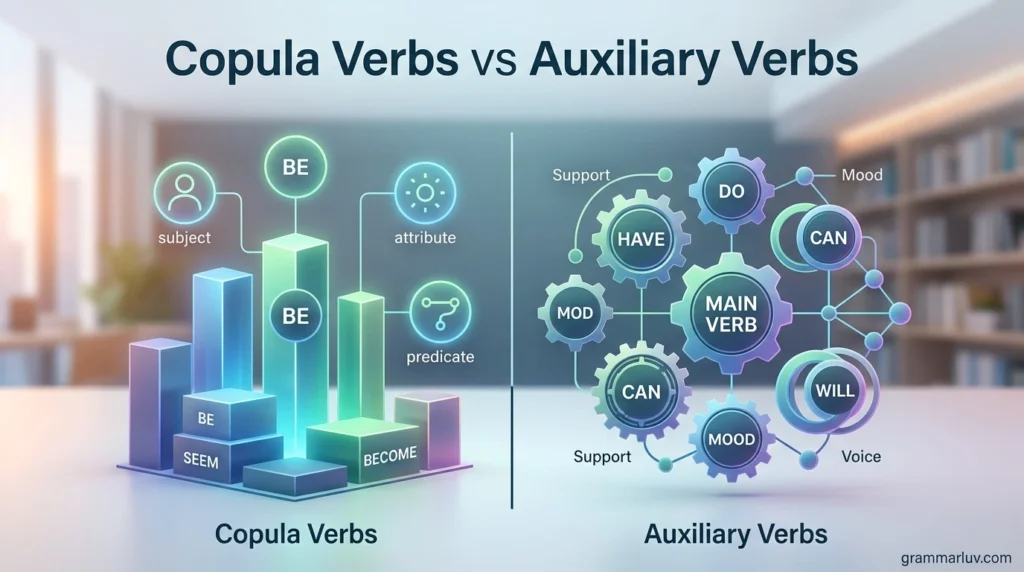
A copula verb, also known as a linking verb, connects the subject of a sentence to information that describes or identifies it.
Unlike action verbs, copula verbs do not show action. Instead, they create a relationship between the subject and a subject complement.
Basic Structure
Subject + Copula Verb + Complement
Examples
- Sarah is intelligent.
- The flowers are beautiful.
- My brother became a doctor.
- The soup tastes wonderful.
In these sentences, the verbs connect the subject to additional information rather than showing action.
Common Copula Verbs
- be
- am
- is
- are
- was
- were
- become
- seem
- appear
- remain
- feel
- look
- smell
- sound
- taste
Functions of Copula Verbs
Copula verbs primarily perform three functions.
1. Identifying
They identify who or what something is.
Examples
- Emma is a teacher.
- That man became the manager.
2. Describing
They describe characteristics or conditions.
Examples
- The sky is blue.
- The room looks clean.
3. Expressing States
They show physical or emotional states.
Examples
- She feels tired.
- They remain hopeful.
These verbs are common in descriptive language because they help writers provide details about people, places, and situations.
What Are Auxiliary Verbs?
Auxiliary verbs, often called helping verbs, assist the main verb in expressing tense, mood, voice, or emphasis.
Unlike copula verbs, auxiliary verbs do not usually function as the main meaning-bearing verb.
Examples
- She is studying.
- They have finished.
- We will travel tomorrow.
- He does not understand.
The helping verb works with the main verb to create a complete grammatical structure.
Common Auxiliary Verbs
Primary Auxiliaries
- be
- have
- do
Modal Auxiliaries
- can
- could
- may
- might
- shall
- should
- will
- would
- must
Functions of Auxiliary Verbs
Auxiliary verbs perform several important grammatical functions.
Creating Tenses
Examples
- She is reading.
- They have arrived.
- We had finished.
Forming Questions
Examples
- Do you understand?
- Have they arrived?
- Can she swim?
Creating Negatives
Examples
- I do not agree.
- She has not called.
- They cannot attend.
Showing Possibility or Ability
Examples
- He may come later.
- She can speak French.
- They might win.
Quick Comparison Table
| Feature | Copula Verbs | Auxiliary Verbs |
| Purpose | Link subject to complement | Help main verb |
| Show action | No | Support action |
| Can stand alone | Usually yes | Usually no |
| Describe subject | Yes | No |
| Form tenses | No | Yes |
| Form questions | No | Yes |
| Form negatives | No | Yes |
Example Comparison
| Sentence | Verb Type |
| She is happy. | Copula |
| She is running. | Auxiliary |
| They were excited. | Copula |
| They were dancing. | Auxiliary |
Notice that the same word can serve different functions depending on context.
How to Identify the Difference
A simple test can help determine whether a verb is a copula or an auxiliary.
Ask This Question:
Is the verb connecting the subject to a description?
If yes, it is probably a copula verb.
Example
- The cake is delicious.
“Is” links the cake with the description “delicious.”
Another Question:
Is the verb helping another verb?
If yes, it is probably an auxiliary verb.
Example
- The cake is baking.
“Is” helps the verb “baking.”
Copula Verbs in Creative Writing and Literature
Creative writing often relies on copula verbs to create vivid descriptions.
Descriptive Examples
- The forest was mysterious.
- Her voice sounded gentle.
- The evening seemed endless.
These structures help readers visualize scenes and understand emotions.
In Figurative Language
Copula verbs frequently appear in literary devices such as metaphors and similes.
Metaphor Examples
- Time is a thief.
- Knowledge is power.
- Life is a journey.
Simile Examples
- Her smile was like sunshine.
- The water looked like glass.
The copula verb links two ideas and strengthens poetic expression.
Auxiliary Verbs in Effective Communication
Auxiliary verbs make communication precise by expressing time, possibility, and certainty.
Present Continuous
- She is writing.
- They are studying.
Present Perfect
- He has completed the project.
- We have learned a lot.
Future Tense
- I will call tomorrow.
- They will arrive soon.
Possibility
- She may attend.
- They might succeed.
These forms allow speakers and writers to communicate subtle meanings accurately.
Common Mistakes Students Make
Understanding these errors can improve writing skills significantly.
Mistake 1: Confusing Functions of “Be”
Incorrect Analysis:
- She is happy.
Some learners assume “is” is auxiliary.
Correct:
- “Is” functions as a copula because it links the subject to a description.
Mistake 2: Missing Main Verbs
Incorrect:
- She can.
Correct:
- She can swim.
Auxiliary verbs generally require a main verb.
Mistake 3: Using Double Auxiliaries Incorrectly
Incorrect:
- He does can swim.
Correct:
- He can swim.
Mistake 4: Confusing Linking and Action Meanings
Compare:
- The soup tastes wonderful. (Copula)
- The chef tastes the soup. (Action verb)
The same word can have different grammatical roles.
Sentence Examples by Category
Copula Verb Examples
Identity
- She is an engineer.
- They became friends.
Description
- The building looks modern.
- The flowers smell sweet.
Condition
- He feels sick.
- The weather remains pleasant.
Auxiliary Verb Examples
Continuous Tense
- She is working.
- They are playing.
Perfect Tense
- We have finished.
- He had left.
Modal Usage
- I can help.
- You should study.
- They might arrive.
Tone, Style, and Usage
Different writing situations require different grammatical choices.
Academic Writing
Copula verbs are common when defining concepts.
Examples:
- A noun is a naming word.
- Language is a communication system.
Professional Writing
Auxiliary verbs help express obligations and possibilities.
Examples:
- Employees must follow policies.
- Teams should submit reports.
Creative Writing
Copula verbs support atmosphere and characterization.
Examples:
- The night was silent.
- Her eyes seemed distant.
Conversational English
Both types occur frequently.
Examples:
- I am tired.
- I am working.
When to Use and When to Avoid
Use Copula Verbs When
- Describing people
- Defining concepts
- Identifying objects
- Expressing states
Examples
- The idea is brilliant.
- The student became confident.
Avoid Excessive Copula Verbs
Too many linking structures can make writing weak.
Weak:
- The room was large. The walls were white. The floor was dirty.
Stronger:
- The large room featured white walls and a dirty floor.
Use Auxiliary Verbs When
- Forming tenses
- Asking questions
- Creating negatives
- Expressing modality
Examples
- Have you finished?
- She will arrive soon.
Relationship to Idioms and Figurative Expressions
Understanding verb functions improves comprehension of idiom meaning and figurative expressions.
Idiom Examples
- The situation is up in the air.
- He is under the weather.
Metaphorical Expressions
- Her heart is stone.
- Success is a mountain to climb.
Poetic Expression
- The moon was a silver lantern.
- Hope seemed eternal.
These expressions often depend on linking verbs to connect ideas and imagery.
Practice Exercises
Exercise 1: Identify the Verb Type
Determine whether the highlighted verb is a copula or auxiliary.
- She is excited.
- She is studying.
- They were tired.
- They were dancing.
- He has finished.
Answers
- Copula
- Auxiliary
- Copula
- Auxiliary
- Auxiliary
Exercise 2: Fill in the Blank
Choose the correct verb.
- The flowers ______ beautiful.
- She ______ reading a novel.
- They ______ completed the task.
- The teacher ______ patient.
Suggested Answers
- are
- is
- have
- is
Exercise 3: Rewrite
Identify and explain the function of the verb.
- The cake tastes delicious.
- The cake is baking.
- She seems nervous.
- She has arrived.
Advanced Comparison Examples
| Sentence | Verb Role |
| He is a doctor. | Copula |
| He is working. | Auxiliary |
| The soup smells wonderful. | Copula |
| She has written a novel. | Auxiliary |
| They became friends. | Copula |
| We will travel tomorrow. | Auxiliary |
This side-by-side comparison helps learners recognize patterns more quickly.
FAQs
1. Can the same word be both a copula and an auxiliary?
Yes. Forms of “be” can function as either depending on context.
- She is happy. (Copula)
- She is running. (Auxiliary)
2. Are all linking verbs copula verbs?
Generally yes. Linking verbs connect subjects to complements and perform a copular function.
3. Do auxiliary verbs always need a main verb?
Usually yes. They support another verb rather than carrying the main meaning alone.
4. Why is understanding these verbs important?
They improve grammar accuracy, writing skills, reading comprehension, and communication.
5. Which verb type is more common?
Both appear frequently in everyday English because they serve different grammatical purposes.
Conclusion
Understanding the difference between copula verbs and auxiliary verbs is essential for mastering English grammar. Copula verbs connect a subject to information that identifies, describes, or explains it, while auxiliary verbs help the main verb express tense, mood, voice, possibility, or emphasis.
Recognizing their functions improves sentence construction, vocabulary enhancement, descriptive language, academic writing, creative writing, and everyday communication. Whether you’re analyzing literary devices, interpreting idiom meaning, creating metaphor examples, studying poetic expression, or simply improving your grammar, knowing how these verbs operate will make your writing clearer, stronger, and more effective.