
Introduction: Why Figurative Language and Precise Word Choice Matter in Writing
Strong communication depends on more than grammar alone. Writers, students, and English learners improve their writing skills when they choose words accurately and understand how language functions in different contexts. Whether you’re creating academic essays, business emails, creative writing pieces, or poetic expression, correct word choice helps readers understand your message clearly.
Figurative language, descriptive language, literary devices, simile examples, metaphor examples, and idiomatic expressions all make writing more engaging. However, even simple word combinations can create confusion. One common example is deciding whether to write time off or time-off.
Many English learners encounter this issue because both forms appear in books, articles, workplace policies, and everyday conversations. Understanding when to use each form will enhance your vocabulary, improve sentence construction, and strengthen professional and academic writing.
This guide explains the meaning, grammatical differences, usage rules, sentence examples, common mistakes, exercises, and practical applications of these closely related terms.
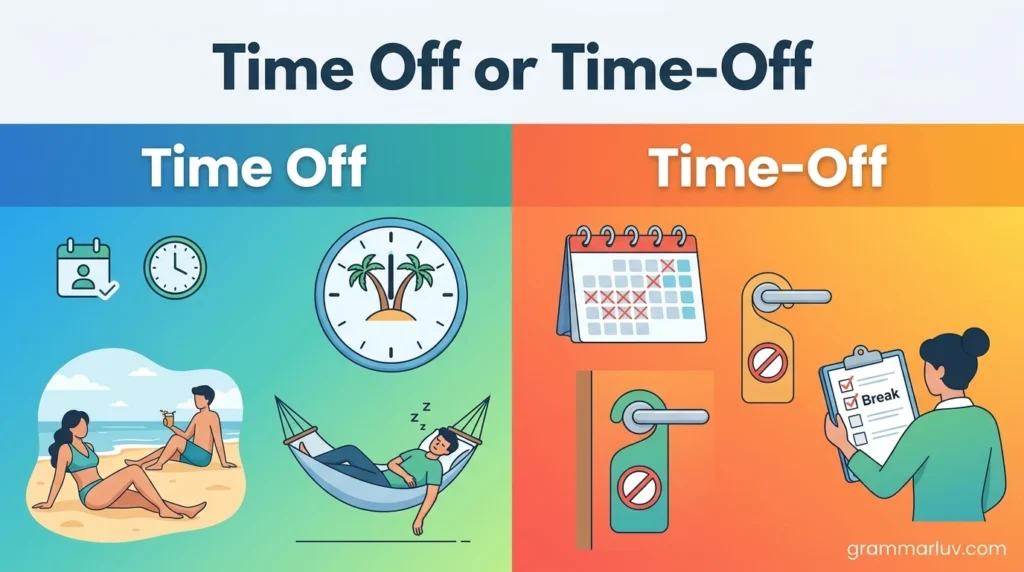
What Does Time Off Mean?
The phrase “time off” refers to a period when someone is not working, studying, or performing regular responsibilities. It usually means taking a break for rest, vacation, personal matters, illness, or recreation.
As a noun phrase, it functions as a concept rather than a modifier.
Meaning
Time off means:
- Leave from work
- Vacation period
- Personal leave
- Rest period
- Break from responsibilities
Examples
- I need some time off after completing the project.
- She requested time off to attend a family event.
- Employees receive paid time off every year.
- Students sometimes need time off to recover from stress.
- After months of preparation, he took time off to travel.
In all these examples, “time off” acts as a noun phrase describing a period away from regular duties.
What Does Time-Off Mean?
“Time-off” with a hyphen functions as a compound adjective. It describes a noun rather than standing alone.
Meaning
When hyphenated, it modifies another word.
Examples include:
- time-off request
- time-off policy
- time-off benefits
- time-off program
Examples
- The company updated its time-off policy.
- Employees completed a time-off request form.
- The manager reviewed the time-off schedule.
- Our organization offers generous time-off benefits.
- She submitted a time-off application last week.
Notice that the hyphenated version appears before a noun and acts like an adjective.
Quick Comparison Table
| Feature | Time Off | Time-Off |
| Part of Speech | Noun Phrase | Compound Adjective |
| Hyphen Needed? | No | Yes |
| Used Alone? | Yes | Usually No |
| Describes a Noun? | No | Yes |
| Example | I need time off. | I submitted a time-off request. |
Simple Rule
Use time off when referring to the break itself.
Use time-off when describing a noun.
Why English Uses Hyphenated Compound Adjectives
English often joins two words with a hyphen when they work together to describe another noun.
Examples:
| Compound Adjective | Example |
| Full-time | Full-time employee |
| Part-time | Part-time worker |
| Well-known | Well-known author |
| Long-term | Long-term plan |
| Time-off | Time-off request |
The hyphen helps readers understand that the words function together as one descriptive unit.
Without the hyphen, readers may momentarily misunderstand the sentence structure.
Comparison Examples
Correct:
- The company approved my time-off request.
Less clear:
- The company approved my time off request.
Although some style guides may accept the second version, the hyphen improves clarity.
Time Off in Everyday Communication
The noun phrase appears frequently in conversations and workplace communication.
Common Situations
Vacation
- I’m taking time off next month.
- She planned time off during summer break.
Health Reasons
- The doctor recommended time off for recovery.
- He needed time off after surgery.
Family Responsibilities
- Parents sometimes require time off for childcare.
- She requested time off for a family emergency.
Education
- Students occasionally take time off to focus on personal matters.
- He took time off before starting university.
Workplace Expressions
Common phrases include:
- paid time off
- unpaid time off
- request time off
- take time off
- approved time off
- earned time off
Time-Off as a Workplace and Business Term
In professional environments, the hyphenated form often appears in official documents.
Examples
- time-off policy
- time-off management system
- time-off request form
- time-off tracking software
- time-off approval process
Sample Sentences
- The HR department revised the time-off guidelines.
- Employees must follow the time-off approval procedure.
- The new time-off system simplifies scheduling.
- Managers review all time-off requests weekly.
Business writing often favors hyphenation because it creates concise and professional descriptions.
Sentence Examples by Category
Academic Writing
- Students sometimes need time off to manage stress.
- The university approved her time-off accommodation request.
Professional Writing
- I would like to request time off next Friday.
- Please complete the time-off request form.
Casual Conversation
- I’m taking some time off next week.
- Everyone deserves time off occasionally.
Formal Communication
- The employee’s time-off request was approved.
- Our organization provides paid time off annually.
Creative Writing
- After years of struggle, she finally took time off and listened to the quiet rhythm of life.
- The time-off journey became an opportunity for self-discovery.
Time Off in Figurative Language and Creative Writing
Although the phrase usually has a literal meaning, creative writers often use it symbolically.
Metaphor Examples
A metaphor directly compares one thing to another.
Examples:
- His vacation was time off from the storms of life.
- The weekend became her island of time off in a sea of obligations.
Simile Examples
A simile uses words such as “like” or “as.”
Examples:
- Time off felt like sunshine after endless rain.
- The holiday arrived like a breath of fresh air.
Poetic Expression
Writers may use the concept of rest to symbolize renewal, freedom, or personal growth.
Example:
Time off unfolded like a quiet garden, allowing forgotten dreams to bloom again.
Descriptive Language
Examples:
- peaceful time off
- refreshing time off
- well-earned time off
- restorative time off
- rejuvenating time off
Such descriptive language enhances reader engagement and emotional impact.
Related Idioms and Expressions
English contains several idioms related to rest and breaks.
Take a Break
Meaning: Stop working temporarily.
Example:
- You should take a break after studying for hours.
Recharge Your Batteries
Meaning: Recover energy.
Example:
- She took a vacation to recharge her batteries.
Get Away From It All
Meaning: Escape daily responsibilities.
Example:
- They traveled to the mountains to get away from it all.
Catch Your Breath
Meaning: Recover after effort.
Example:
- He needed a moment to catch his breath after the busy season.
Step Back
Meaning: Pause and reassess.
Example:
- Sometimes taking time off allows people to step back and gain perspective.
Understanding idiom meaning strengthens vocabulary enhancement and reading comprehension.
Common Mistakes and How to Avoid Them
Mistake 1: Hyphenating the Noun Phrase
Incorrect:
- I need time-off next week.
Correct:
- I need time off next week.
Reason:
The phrase functions as a noun, not an adjective.
Mistake 2: Forgetting the Hyphen Before a Noun
Less Clear:
- She submitted a time off request.
Preferred:
- She submitted a time-off request.
Reason:
The phrase modifies “request.”
Mistake 3: Using Both Forms Interchangeably
Incorrect:
- My company offers excellent time off benefits.
Preferred:
- My company offers excellent time-off benefits.
Reason:
The phrase describes “benefits.”
Mistake 4: Overusing Hyphens
Not every word combination requires a hyphen.
Writers should identify whether the phrase acts as a modifier or a standalone noun phrase.
When to Use Each Form
Use “Time Off” When:
✔ Mentioning breaks from work or school
Examples:
- I requested time off.
- We enjoyed some time off.
- She needs time off to recover.
Use “Time-Off” When
Examples:
- time-off request
- time-off schedule
- time-off policy
- time-off benefits
Tone and Style Considerations
Different writing situations require different tones.
Formal Tone
- Employees receive paid time off annually.
- The time-off policy is available online.
Neutral Tone
- I plan to take time off next month.
- Please submit your time-off request early.
Friendly Tone
- Everyone deserves a little time off now and then.
- Enjoy your well-earned time off!
Creative Tone
- Her time off became a doorway to new possibilities.
- The quiet days of time off restored her spirit.
Adjusting tone improves communication effectiveness.
Practice Exercises
Exercise 1: Choose the Correct Form
- I need ______ next week.
- The company updated its ______ policy.
- She requested ______ after the conference.
- Please complete the ______ form.
- Employees earn paid ______ every year.
Answers
- time off
- time-off
- time off
- time-off
- time off
Exercise 2: Correct the Errors
- I submitted a time off request.
- She plans to take time-off tomorrow.
- Our company offers excellent time off benefits.
Corrected Versions
- I submitted a time-off request.
- She plans to take time off tomorrow.
- Our company offers excellent time-off benefits.
Vocabulary Enhancement: Similar Words and Synonyms
Depending on context, alternatives include:
| Word | Meaning |
| Vacation | Extended leisure period |
| Leave | Authorized absence |
| Break | Short rest period |
| Holiday | Day of celebration or rest |
| Respite | Relief from difficulty |
| Pause | Temporary stop |
| Sabbatical | Extended leave |
| Retreat | Withdrawal for rest or reflection |
Using varied vocabulary improves writing quality and prevents repetition.
Summary Comparison Table
| Situation | Correct Form |
| I need a break from work. | Time off |
| Employee leave period | Time off |
| Company leave policy | Time-off |
| Request document | Time-off |
| Vacation discussion | Time off |
| HR paperwork | Time-off |
| Casual conversation | Time off |
| Business modifier | Time-off |
FAQs
1. Is “time off” one word or two words?
It is typically written as two words when referring to a break from work, school, or responsibilities.
2. When should I use “time-off” with a hyphen?
Use the hyphenated form when it functions as a compound adjective before a noun, such as “time-off request” or “time-off policy.”
3. Is “paid time off” hyphenated?
No. “Paid time off” usually remains unhyphenated because “time off” functions as a noun phrase.
4. Can I write “time off request” without a hyphen?
Some readers may understand it, but many style guides prefer “time-off request” because it clearly forms a compound modifier.
5. Which form appears more often in workplace documents?
The hyphenated form frequently appears in policies, forms, schedules, and HR documentation when modifying another noun.
Conclusion
Understanding the difference between time off or time-off is a valuable grammar skill for students, writers, professionals, and English learners. The distinction is simple once you recognize the grammatical role each form plays. Use time off as a noun phrase referring to a break, vacation, or leave period. Use time-off as a compound adjective that describes a noun, such as a request, policy, or benefit.
Mastering this rule improves writing accuracy, strengthens professional communication, enhances vocabulary, and helps avoid common grammar mistakes. Whether you’re drafting workplace documents, writing academic assignments, exploring creative writing, or studying English grammar, knowing when to use each form will make your writing clearer, more polished, and more effective.