
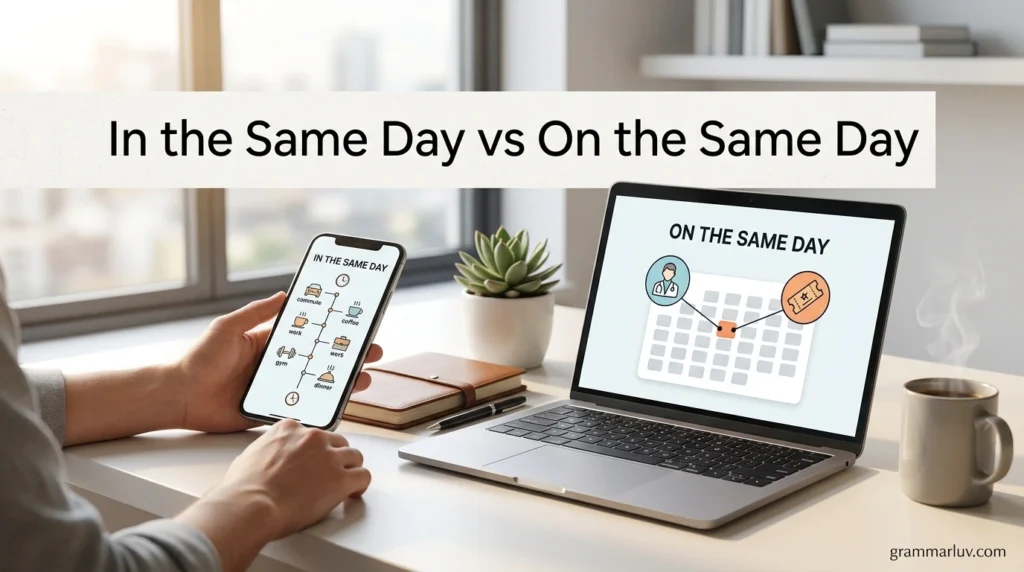
Language is more than a tool for communication—it is a way to create emotion, imagery, clarity, and connection. Strong writing often depends on descriptive language, figurative language, and precise word choice. Even small phrases can change the tone and meaning of a sentence. One common point of confusion for students, writers, and English learners is the difference between “in the same day” and “on the same day.”
Although these expressions appear similar, they are used differently in grammar, sentence structure, creative writing, and everyday communication. Understanding their meanings can improve writing skills, vocabulary enhancement, and overall fluency in English.
This guide explains the differences in detail using comparison examples, sentence examples, literary-style explanations, tone analysis, and practical exercises. Whether you are improving academic writing, learning English, or exploring poetic expression, this article will help you use these phrases correctly and confidently.
Understanding Time Expressions in English
English uses prepositions such as in, on, and at to describe time. These small words may seem simple, but they significantly affect meaning and sentence clarity.
Common Time Prepositions
PrepositionTypical UseExampleInLonger periods or within a time framein a weekOnSpecific days or dateson MondayAtExact timesat 6 PM
Because “same day” refers to time, choosing the correct preposition depends on whether you mean:
- A specific calendar day
- A time period within one day
- An event occurring during the same day
- A completed action inside a day
This is why learners often confuse these two expressions.
What Does “On the Same Day” Mean?
“On the same day” refers to two or more events happening on one specific calendar day.
It focuses on the date itself rather than the duration of time.
Basic Meaning
If two things happen “on the same day,” they occur on one shared day.
Sentence Examples
- The wedding and graduation happened on the same day.
- She submitted the assignment and received feedback on the same day.
- Two major announcements were made on the same day.
Tone and Usage
This phrase is:
- Neutral
- Common in formal writing
- Frequently used in academic and professional communication
- Clear and direct
Best Situations to Use It
Use “on the same day” when:
- Discussing schedules
- Comparing events
- Describing historical events
- Writing reports or essays
- Explaining timelines
Academic Example
- The experiment began and ended on the same day.
Creative Writing Example
- The sun disappeared and the rain arrived on the same day, changing the village forever.
This phrase is highly useful in descriptive language because it creates a sense of coincidence or connection between events.
What Does “In the Same Day” Mean?
“In the same day” emphasizes completion or occurrence within a single day period.
It focuses more on duration and time span than on the date itself.
Basic Meaning
The phrase suggests something happened during one day or within a day’s limits.
Sentence Examples
- She read two novels in the same day.
- He traveled across three cities in the same day.
- The team solved the issue in the same day.
Tone and Usage
This phrase often sounds:
- Slightly more conversational
- Time-focused
- Emphatic about speed or productivity
Best Situations to Use It
Use “in the same day” when:
- Talking about achievements
- Emphasizing quick completion
- Highlighting productivity
- Describing actions completed within one day
Writing Example
- The artist painted three portraits in the same day, astonishing everyone.
This usage adds dramatic emphasis, making it useful in storytelling and poetic expression.
Quick Comparison Table
FeatureOn the Same DayIn the Same DayFocusSpecific day/dateTime span within a dayMeaningEvents share one dayAction completed during one dayToneFormal and neutralConversational or emphaticCommon UseScheduling and timelinesProductivity and achievementGrammar FocusCalendar referenceDuration reference
Why English Learners Confuse These Phrases

Many English learners struggle with prepositions because their native language may not use separate forms for dates and duration.
Common Reasons for Confusion
- Both phrases mention “same day”
- Both relate to time
- Prepositions are difficult in English
- Literal translation causes errors
- Native speakers sometimes use them casually
Incorrect Example
- I finished the project on the same day.
This sentence is not always wrong, but if the emphasis is on completing the project within one day, “in the same day” is clearer.
Better Version
- I finished the project in the same day.
Grammar Breakdown and Sentence Structure
Understanding grammar patterns helps learners use these phrases accurately.
Structure of “On the Same Day”
Event + happened + on the same day
Examples:
- The meetings occurred on the same day.
- Their birthdays fall on the same day.
This structure points to a shared date.
Structure of “In the Same Day”
Action + completed + in the same day
Examples:
- She wrote the essay in the same day.
- We repaired the system in the same day.
This structure highlights completion within a limited period.
Formal Writing vs Creative Writing Usage
Writers choose expressions based on tone, audience, and purpose.
Formal Writing
Formal and academic writing usually prefers “on the same day” because it sounds clearer and more precise.
Example
- The contract was signed and approved on the same day.
Creative Writing
Creative writing often uses “in the same day” for emotional impact or dramatic pacing.
Example
- He lost his job and found hope again in the same day.
This creates emotional movement and narrative intensity.
Figurative Language and Time Expressions
Although these phrases are not literary devices themselves, they can strengthen figurative language when used creatively.
Example with Metaphor
- Her world collapsed and rebuilt itself in the same day.
The sentence uses metaphor examples by comparing emotional change to physical destruction and reconstruction.
Example with Simile
- The hours disappeared on the same day like leaves in the wind.
This includes simile examples because it compares passing time to falling leaves using “like.”
Poetic Expression
Writers use time expressions to create rhythm and emotional contrast.
Poetic Example
- Joy and sorrow arrived on the same day, walking hand in hand.
This sentence demonstrates descriptive language and poetic expression.
Literary Devices Connected to Time-Based Writing
Writers often combine time expressions with literary devices to create stronger imagery and meaning.
Imagery
- The city changed colors in the same day.
Contrast
- She laughed and cried on the same day.
Symbolism
A “day” may symbolize:
- Change
- Transformation
- Opportunity
- Emotional cycles
Hyperbole
- He answered a hundred emails in the same day.
This exaggeration emphasizes effort or productivity.
Common Mistakes Students Make

1. Using the Wrong Preposition
Incorrect:
- I completed the test on the same day.
Better:
- I completed the test in the same day.
2. Confusing Date with Duration
Incorrect:
- Their birthdays happened in the same day.
Better:
- Their birthdays happened on the same day.
3. Overusing the Phrases
Repeating these expressions too often weakens writing quality.
Instead, vary your vocabulary with phrases like:
- during the day
- within one day
- that very day
- simultaneously
- in a single day
Vocabulary Enhancement Through Similar Expressions
Learning related phrases improves writing variety and fluency.
Similar Alternatives
PhraseMeaningWithin one dayCompleted before a day endedThat very dayHappened exactly that dayDuring the dayHappened sometime in the daySimultaneouslyHappened at the same timeOvernightHappened very quickly
Example Comparisons
- She finished the report within one day.
- She finished the report in the same day.
Both are understandable, but the first sounds slightly more natural.
Real-Life Examples in Different Contexts
Academic Context
- The professor assigned and reviewed the essay on the same day.
Business Context
- The company processed the request in the same day.
News Reporting
- Two major storms struck on the same day.
Casual Conversation
- I cleaned the house and cooked dinner in the same day.
Creative Narrative
- He fell in love and lost everything on the same day.
Tone Differences and Emotional Impact
The phrase you choose can affect the emotional tone of your writing.
“On the Same Day”
This expression sounds:
- Objective
- Informative
- Chronological
Example
- The decisions were announced on the same day.
“In the Same Day”
This expression sounds:
- Dramatic
- Impressive
- Emotional
Example
- She transformed her life in the same day.
Writers often choose the second version for storytelling because it creates stronger emotional emphasis.
When to Avoid These Expressions
Sometimes simpler wording works better.
Avoid Overcomplicated Sentences
Weak:
- The meeting and interview occurred on the same day during the same week.
Better:
- The meeting and interview happened on Monday.
Avoid Repetition
Using these phrases repeatedly can reduce readability.
Avoid Ambiguity
If the meaning is unclear, specify the exact date or time.
Exercises for Students and English Learners
Try these exercises to improve understanding.
Exercise 1: Choose the Correct Phrase
- She completed three assignments ___.
- Their birthdays are ___.
- He traveled to two countries ___.
- The ceremonies took place ___.
Answers
- in the same day
- on the same day
- in the same day
- on the same day
Exercise 2: Rewrite the Sentences
Rewrite using clearer wording.
- I finished the book on the same day.
- The matches happened in the same day.
Suggested Answers
- I finished the book in the same day.
- The matches happened on the same day.
Exercise 3: Creative Writing Practice
Write sentences using:
- a simile
- a metaphor
- descriptive language
- emotional contrast
Example:
- Hope arrived in the same day like sunlight after rain.
Tips to Improve Writing Skills with Time Expressions
Read Widely
Study novels, essays, and articles to see natural usage patterns.
Practice Sentence Variety
Avoid repeating the same structures.
Learn Through Context
Focus on meaning rather than memorization.
Use Figurative Language Carefully
Adding metaphor examples and simile examples can make writing more engaging.
Edit for Clarity
Ask:
- Does this sentence refer to a date?
- Or does it emphasize completion within a day?
FAQs
1. Which phrase is more common in English?
“On the same day” is generally more common and natural in formal English.
2. Is “in the same day” grammatically correct?
Yes, it is grammatically correct when emphasizing completion within one day.
3. Can both phrases sometimes work?
Yes. In some contexts, both are understandable, but the nuance changes slightly.
4. Which phrase is better for academic writing?
“On the same day” is usually preferred because it sounds more precise and formal.
5. Which phrase sounds more emotional in storytelling?
“In the same day” often creates stronger dramatic or emotional emphasis.
Final Thoughts
Understanding subtle differences in English expressions can dramatically improve communication. The distinction between these two phrases may seem small, but it affects clarity, tone, grammar, and style.
“On the same day” is best when referring to shared dates or events occurring on one calendar day. “In the same day” works better when emphasizing completion, speed, or multiple actions within a single day period.
For students, writers, and English learners, mastering these expressions strengthens writing skills and vocabulary enhancement while improving sentence clarity and fluency. When combined with figurative language, literary devices, descriptive language, and poetic expression, even simple time phrases can make writing more vivid and engaging.
The key is understanding context. Once you know whether you are emphasizing a specific date or a completed duration, choosing the correct phrase becomes much easier.