
Similes are one of the most powerful tools in figurative language. A simile compares two different things using the words “like” or “as.” For example, “Her smile is like sunshine” creates a vivid image in the reader’s mind. Writers and teachers love similes because they make ideas clearer, emotions stronger, and descriptions more memorable.
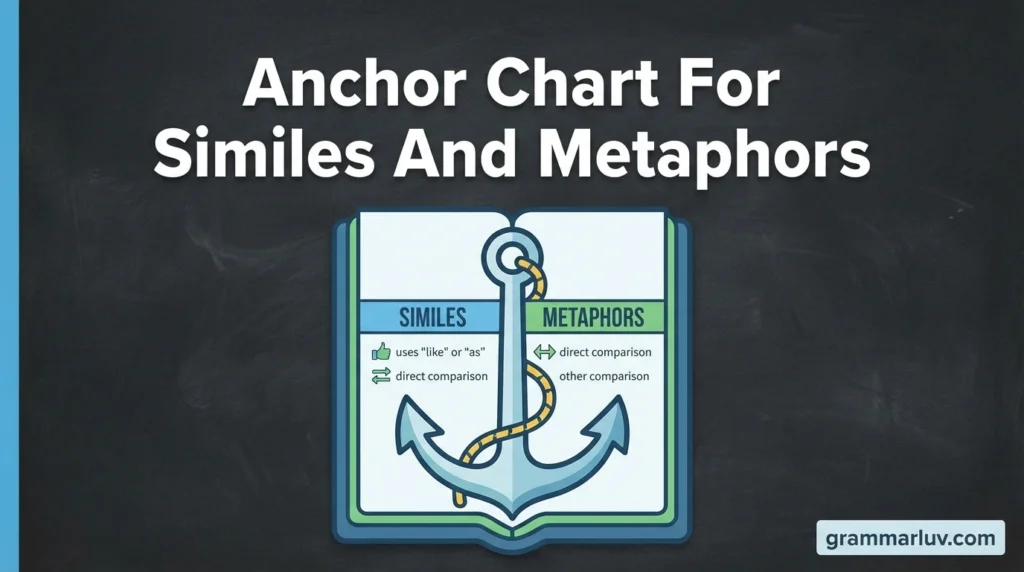
In classrooms, anchor charts are often used to explain concepts visually. An anchor chart for similes and metaphors helps students quickly understand the difference between the two, recognize signal words, and apply figurative language in writing. Whether you are a teacher creating classroom decor, a homeschooling parent, or a student improving creative writing skills, this guide will help you build powerful, engaging examples.
Below, you’ll find 25 creative similes centered around the idea of an anchor chart for similes and metaphors. Each section explains the meaning, tone, best usage context, and includes multiple natural examples you can use in lessons, writing prompts, or even daily conversation.
As Clear As A Window On A Sunny Day
Meaning: An anchor chart for similes and metaphors should make concepts transparent and easy to understand.
Tone: Positive, bright, encouraging.
Best Usage Context: Teaching clarity, classroom explanation, educational blog writing.
When students look at an anchor chart, they should immediately “see through” confusion. This simile emphasizes clarity and simplicity.
Examples:
- The anchor chart for similes and metaphors was as clear as a window on a sunny day, and every student understood the lesson.
- Her explanation was as clear as a window on a sunny day because she used a well-designed anchor chart.
- With bold headings and examples, the chart became as clear as a window on a sunny day.
Daily-Use Sentence:
- “I finally understand similes and metaphors—your chart made it crystal clear!”
Like A Roadmap Through A Forest
Meaning: The chart guides learners through confusing material.
Tone: Supportive and guiding.
Best Usage Context: Educational training, lesson planning discussions.
Similes and metaphors can feel overwhelming at first. A strong anchor chart acts like a roadmap, preventing students from getting “lost.”
Examples:
- The anchor chart for similes and metaphors was like a roadmap through a forest of confusing grammar rules.
- Without the chart, the lesson felt chaotic, but with it, everything was like a roadmap through a forest.
- For struggling learners, that chart worked like a roadmap through a forest.
Texting Example:
- “That chart saved me—it’s like a roadmap for figurative language!”
As Bright As A Highlighter On Fresh Paper
Meaning: The chart stands out and grabs attention.
Tone: Energetic and lively.
Best Usage Context: Classroom decor descriptions, teaching strategies blogs.
An anchor chart should visually pop with color and examples.
Examples:
- The anchor chart for similes and metaphors was as bright as a highlighter on fresh paper.
- Her colorful headings were as bright as a highlighter on fresh paper.
- The classroom wall looked alive, as bright as a highlighter on fresh paper.
Daily-Use Sentence:
- “Make your examples bright and bold so students remember them.”
Like A Bridge Between Confusion And Understanding
Meaning: The chart connects ideas clearly.
Tone: Encouraging, hopeful. Best Usage Context: Teacher training, educational writing.
Similes and metaphors can seem abstract. A strong chart builds connection.
Examples:
- The anchor chart for similes and metaphors acted like a bridge between confusion and understanding.
- For visual learners, the chart was like a bridge between confusion and understanding.
- With clear examples, it became like a bridge students could easily cross.
As Helpful As A Teacher’s Guiding Hand
Meaning: The chart supports and assists learners.
Tone: Warm and supportive. Best Usage Context: Educational reflection, lesson planning.
Examples:
- The anchor chart for similes and metaphors was as helpful as a teacher’s guiding hand.
- During independent writing, the chart stood as helpful as a teacher’s guiding hand.
- Whenever students hesitated, the chart was as helpful as a teacher’s guiding hand.
Like A Flashlight In The Dark
Meaning: It provides clarity when things feel confusing.
Tone: Dramatic but positive. Best Usage Context: Describing breakthroughs in learning.
Examples:
- The anchor chart for similes and metaphors was like a flashlight in the dark.
- When grammar seemed confusing, the chart worked like a flashlight in the dark.
- It felt like a flashlight guiding us through figurative language.
As Strong As An Oak Tree
Meaning: The chart is reliable and dependable.
Tone: Confident and stable. Best Usage Context: Describing foundational teaching tools.
Examples:
- The anchor chart for similes and metaphors stood as strong as an oak tree.
- Year after year, the chart remained as strong as an oak tree.
- It provided support as strong as an oak tree in a storm.
Like A Compass For Young Writers
Meaning: It gives direction in writing.
Tone: Inspirational. Best Usage Context: Creative writing classrooms.
Examples:
- The anchor chart for similes and metaphors was like a compass for young writers.
- When drafting essays, the chart worked like a compass.
- It pointed students in the right direction like a compass.
As Organized As A Neatly Labeled Library
Meaning: Structured and easy to follow.
Tone: Calm and professional. Best Usage Context: Instructional design.
Examples:
- The anchor chart for similes and metaphors was as organized as a neatly labeled library.
- Each section was as organized as a neatly labeled library.
- Students found examples quickly because it was as organized as a library.
Like A Safety Net For Learning
Meaning: Prevents mistakes and builds confidence.
Tone: Supportive. Best Usage Context: Encouraging hesitant learners.
Examples:
- The anchor chart for similes and metaphors worked like a safety net for learning.
- Even shy students felt secure, like they had a safety net.
- It caught small mistakes like a safety net beneath a performer.
As Refreshing As A Cool Breeze
Meaning: Makes learning enjoyable.
Tone: Light and pleasant.
Examples:
- The anchor chart for similes and metaphors felt as refreshing as a cool breeze.
- The lesson became as refreshing as a cool breeze.
- Students smiled, feeling as refreshed as after a cool breeze.
Like A Toolbox Full Of Writing Tools
Meaning: Provides multiple strategies and examples.
Tone: Practical and empowering.
Examples:
- The anchor chart for similes and metaphors was like a toolbox full of writing tools.
- Each example worked like a different tool in a toolbox.
- Students reached for it like a toolbox during drafting.
As Reliable As A Morning Alarm
Meaning: Consistent and dependable reference.
Tone: Practical.
Examples:
- The anchor chart for similes and metaphors was as reliable as a morning alarm.
- Every lesson began with something as reliable as a morning alarm.
- Students checked it as reliably as an alarm clock.
Like A Spark That Ignites Creativity
Meaning: Inspires imagination. Tone: Motivational.
Examples:
- The anchor chart for similes and metaphors was like a spark that ignites creativity.
- After reading it, ideas flew like sparks.
- It lit up the room like a creative spark.
As Simple As A Step-By-Step Recipe
Meaning: Easy to follow instructions. Tone: Clear and instructional.
Examples:
- The anchor chart for similes and metaphors was as simple as a step-by-step recipe.
- Students followed it as easily as a recipe.
- Writing became as simple as baking from a recipe.
Like A Map To Hidden Treasure
Meaning: Leads to discovery and insight. Tone: Adventurous and exciting.
Examples:
- The anchor chart for similes and metaphors was like a map to hidden treasure.
- Students searched for similes like treasure hunters.
- It guided them like a treasure map.
As Balanced As A Scale
Meaning: Clearly distinguishes similes and metaphors equally. Tone: Fair and structured.
Examples:
- The anchor chart for similes and metaphors was as balanced as a scale.
- It compared both equally, as balanced as a scale.
- The design felt fair and balanced like a scale.
Like A Friendly Guide On A Journey
Meaning: Encouraging and approachable. Tone: Warm.
Examples:
- The anchor chart for similes and metaphors was like a friendly guide.
- It walked students through examples like a guide.
- Learning felt like a guided tour.
As Eye-Catching As A Billboard
Meaning: Visually engaging. Tone: Bold.
Examples:
- The anchor chart for similes and metaphors was as eye-catching as a billboard.
- Students noticed it instantly, like a billboard.
- Its colors stood out like a roadside billboard.
Like A Ladder To Higher-Level Writing
Meaning: Helps students improve. Tone: Ambitious and growth-oriented.
Examples:
- The anchor chart for similes and metaphors was like a ladder to higher-level writing.
- Each example was a rung on a ladder.
- Students climbed toward better writing like on a ladder.
As Encouraging As Applause
Meaning: Boosts confidence. Tone: Uplifting.
Examples:
- The anchor chart for similes and metaphors felt as encouraging as applause.
- When students used it, it felt like applause.
- It motivated them like cheering applause.
Like A Puzzle Piece That Completes The Lesson
Meaning: Essential finishing element. Tone: Satisfying.
Examples:
- The anchor chart for similes and metaphors was like a puzzle piece.
- It completed the lesson like the final puzzle piece.
- Everything clicked into place like a puzzle.
As Flexible As Clay
Meaning: Adaptable for different grade levels. Tone: Creative and adaptable.
Examples:
- The anchor chart for similes and metaphors was as flexible as clay.
- Teachers shaped it like clay for different grades.
- It adjusted like clay in skilled hands.
Like A Spotlight On Key Concepts
Meaning: Highlights important ideas. Tone: Focused and clear.
Examples:
- The anchor chart for similes and metaphors worked like a spotlight.
- It put simile signal words under a spotlight.
- Metaphors stood clearly under the spotlight.
As Memorable As A Catchy Song
Meaning: Stays in students’ minds. Tone: Fun and engaging.
Examples:
- The anchor chart for similes and metaphors was as memorable as a catchy song.
- Students remembered it like a favorite tune.
- Its examples stuck like lyrics of a catchy song.
Conclusion
An effective anchor chart for similes and metaphors is more than classroom decoration. It is a bridge, a compass, a spark, and sometimes even a safety net. When thoughtfully designed with clear examples, visual organization, and engaging comparisons, it transforms abstract figurative language into something students can see, understand, and confidently use.
Similes bring writing to life. They make lessons vivid, emotions stronger, and explanations clearer. By incorporating meaningful comparisons into your teaching tools, you not only improve comprehension but also inspire creativity. Whether you are guiding young learners or refining advanced writing skills, the right anchor chart can elevate understanding and make figurative language unforgettable.
FAQs
What Is An Anchor Chart For Similes And Metaphors?
An anchor chart for similes and metaphors is a visual classroom tool that explains the difference between similes and metaphors, provides definitions, signal words, and examples to support student understanding.
Why Are Anchor Charts Effective For Teaching Figurative Language?
Anchor charts provide visual reinforcement, structured examples, and easy reference. They help students quickly identify figurative language patterns and apply them in writing.
What Should Be Included In A Similes And Metaphors Anchor Chart?
Include clear definitions, comparison keywords like “like” and “as,” sample sentences, visual cues, and a side-by-side comparison section.
How Can Students Use Anchor Charts During Writing?
Students can reference the chart while drafting essays, stories, or poems to ensure they are using similes and metaphors correctly and creatively.
Are Anchor Charts Suitable For All Grade Levels?
Yes. You can adapt the complexity of examples depending on grade level, making them flexible teaching tools.
How Often Should Teachers Update Anchor Charts?
Anchor charts can remain displayed throughout a unit. Updating them with new student-generated examples increases engagement.
Can Anchor Charts Improve Creative Writing Skills?
Absolutely. By providing structured support and vivid examples, anchor charts encourage students to experiment with figurative language and develop stronger, more expressive writing.